Communication and Construction of Monstrous Embodiment
June 15-16, 2012

Showing posts with label medical photographs. Show all posts

Thursday, 5 April 2012

Rare, Beautiful, Disturbing

First: a reminder that there are only 10 days to register for the conference at the reduced rates. Advanced booking closes on 15 April, and we urge you to take advantage of this offer before it does: see the Fees and Information tab for details and links to the booking website.

Now, we'd like to thank one of our Twitter followers for the following link to Wired Science's sneak peek at the very recently released book Hidden Treasure. The book provides a brief glimpse into the unfathomable depths of the National Library of Medicine's extensive collection as part of the NLM's 175th anniversary celebrations. The Wired Science preview is comprised of images, film rolls, or texts which are distinguished by being rare, beautiful, and disturbing.

The cross-section is an intriguing one, and perhaps indicative of the close-knit relationship between the sensational, and the beautiful/disturbing. A mummified and mutilated hand from Eugène-Louis Doyen's Atlas of Topographic Anatomy (1911), its lines pronounced and severed, seems to be the visualised anticipation of some grotesque touch; the presence of a similarly disembodied hand clutching the shoulder of a bandaged patient in Joseph Jacob-Henri's sketch from Complete Study of the Human Anatomy (1831-54) perverts the reassurance of bodily contact.

The book itself, according to the publisher's description, is an exhibition of objects that 'glow with beauty, grotesquery, wit and/or calamitous tragedy'. Edited by Michael Sappol, the collection includes 'a series never before reproduced of hauntingly delicate paintings and illustrations of “monstra” collected in the early decades of the nineteenth century “from the museum of Dr. Klinkenberg” in the Netherlands; charming hand-painted glass “magic lantern slides,” which doctors projected in slideshows to entertain and help cure inmates at St. Elizabeths Hospital for the Insane; the mimeographed report of the Japanese medical team first to enter Hiroshima after the atomic blast'.

The illustrated "monstra" are exhibited alongside disturbing images of inhumanity, and the anatomical reality of our bodies themselves. The collection also includes x-rays from Adolph Hitler's medical records, illustrations of a man so often deemed monstrous that are unnervingly devoid of the bodily monstrosity depicted elsewhere in the collection. Each treasure is accompanied by a brief essay from distinguished scholars, artists, or physicians, including Lisa O'Sullivan, Mark S. Micale, Jeffrey S. Reznick, Benjamin Reiss, Shigehisa Kuriyama, Susan E. Lederer, and Rosamond Purcell, among many others.

Wednesday, 18 January 2012

Freakery and "Aesthetic Traces"

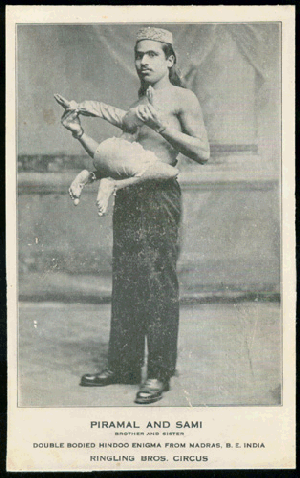
If you happen to be interested in "freaks," freakery, and its relationship to nineteenth-century medical "monsters", we'd like to draw your attention to a fascinating article published in 2005 in the Disability Studies Quarterly, Sheila Moeschen's "Aesthetic Traces in Unlikely Places: Re-visioning the Freak in 19th-Century American Photography". The article, which is open access, offers an intriguing reading of the role that photography played in the creation and presentation of extraordinary bodies in the nineteenth century; Moeschen denies that fictive division which might separate the objective medical photograph from its public side-show counterpart, typically deemed to be more deliberately titillating. Instead, she suggests,
"The two traditions form a reciprocal relationship that illuminates their representational and political imbrications. The historical persistence to delineate between a medical and artistic "aesthetic" reveals a disconcerting bias towards privileging the power and credibility of the empirical realm over the artistic."
Moeschen points to the role that "sensation" played in separating the clinical photograph of medical monstrosity from the "freak portrait", evoking perhaps a distinction between the sensational props and posing of the visual construction of freakery with the potentially sensualised medical photographs which are marked by their nudity in order to reveal the anomalous body more fully to the viewer.

The article focuses on what Moeschen calls the "performative trace," which she sees as characterising the construction of both medical and sensational photographs of individuals with extraordinary bodies, creating "an alternate frame around these subjects that explicitly signals the perceptual and cognitive apparatuses ascribed to performance." She notes that
"The performative trace becomes another presentational "mode" employed, ironically in the case of the medical profession, to disarm these unusual bodies, endowing them with a quality of the ephemeral that ultimately promotes uncritical fascination; it promotes a kind of fetishistic voyeurism and illicit titillation."
The instability which this theatrical element introduces into these photographs is, for Moeschen, a deliberate strategy on the part of both medical and sideshow photographers to manipulate the "cultural and ideological value" of their subjects.