Communication and Construction of Monstrous Embodiment
June 15-16, 2012

Showing posts with label teratology. Show all posts

Wednesday, 18 January 2012

Freakery and "Aesthetic Traces"

If you happen to be interested in "freaks," freakery, and its relationship to nineteenth-century medical "monsters", we'd like to draw your attention to a fascinating article published in 2005 in the Disability Studies Quarterly, Sheila Moeschen's "Aesthetic Traces in Unlikely Places: Re-visioning the Freak in 19th-Century American Photography". The article, which is open access, offers an intriguing reading of the role that photography played in the creation and presentation of extraordinary bodies in the nineteenth century; Moeschen denies that fictive division which might separate the objective medical photograph from its public side-show counterpart, typically deemed to be more deliberately titillating. Instead, she suggests,
"The two traditions form a reciprocal relationship that illuminates their representational and political imbrications. The historical persistence to delineate between a medical and artistic "aesthetic" reveals a disconcerting bias towards privileging the power and credibility of the empirical realm over the artistic."
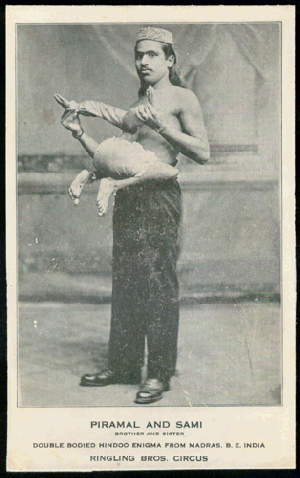
Moeschen points to the role that "sensation" played in separating the clinical photograph of medical monstrosity from the "freak portrait", evoking perhaps a distinction between the sensational props and posing of the visual construction of freakery with the potentially sensualised medical photographs which are marked by their nudity in order to reveal the anomalous body more fully to the viewer.

The article focuses on what Moeschen calls the "performative trace," which she sees as characterising the construction of both medical and sensational photographs of individuals with extraordinary bodies, creating "an alternate frame around these subjects that explicitly signals the perceptual and cognitive apparatuses ascribed to performance." She notes that
"The performative trace becomes another presentational "mode" employed, ironically in the case of the medical profession, to disarm these unusual bodies, endowing them with a quality of the ephemeral that ultimately promotes uncritical fascination; it promotes a kind of fetishistic voyeurism and illicit titillation."
The instability which this theatrical element introduces into these photographs is, for Moeschen, a deliberate strategy on the part of both medical and sideshow photographers to manipulate the "cultural and ideological value" of their subjects.

Thursday, 22 December 2011

Conjoined Twins in the News

This post isn't strictly tied to the theme of sensualising deformity, but given the extraordinary nature of the case and the time of year I felt that it warranted sharing. A pair of conjoined twins of the most rare degree, dicephalic parapagus, where two fully formed heads share a single body, including internal organs, have been born in Brazil.

The amazing thing about this is the fact that both the babies and the mother are alive and, we can assume, healthy. Obviously whether their condition will impact on their development remains to be seen, but at the moment it is simply wonderful that these two boys have survived to term and have been born without any apparent complications.

Perhaps the more disturbing note here is the article's insistent emphasis on separation, which has arisen in spite of the fact that doctors admit it to be impossible; separation in this instance would be "removal", selection one of the children to deliberately kill. That the conversation is taking place despite both twins exhibiting normal brain function and with no visible threat posed by one twin to the health and survival of the other is somewhat unsettling to say the least, but not surprising. To what degree does the assumption that separation is a given play in to legitimate medical concerns, and to what degree does it reflect the same anxieties of human form and human subjectivity which have always plagued conjoined twins?

Today, however, with the twins born only a few days before Christmas and Hanukkah, and right in the midst of the winter holiday season, we'd just like to wish them, and you, all our best. 

Tuesday, 15 November 2011

A Monster Observatory

One of our keynotes, Jeffrey Jerome Cohen, shared this fantastic link with us via his Twitter account, and we wanted to pass it along to our readers as well (share and share alike - it's a good motto).

With a name like A Monster Observatory and a tagline that runs "Cultural Teratology: Freaks, Monsters, the Grotesque", it should be pretty clear why we've taken an interest in this blog. However, if you needed convincing, we would refer you to the most recent post as of today, "Thinking About Monster Theory (Seven Theses)" - ten points if you can guess what it is about.

The site is managed by Dr Ian McCormick, and so far features a wealth of posts on mangled torsos, disability and the fourth plinth, and conjoined twins amongst other topics - in other words, every fascinating aspect of monstrosity, disability, and the grotesque body. If you're reading this blog, then A Monster Observatory probably deserves a spot on your bookmarks toolbar.

We'd also like to take this opportunity to remind everyone that we do acknowledge all inquiries and submissions, so if you have sent in a proposal or a question and haven't heard back, do get in touch. Likewise if you think there's something that our blog readers might find interesting or useful - articles, books (ideally available online), art or museum exhibitions, other blogs, even other conferences. You can send it our way via e-mail, Facebook, or Twitter (all information on the sidebar to your right). Pick your poison - we'd love to hear from you on any platform!

Friday, 9 September 2011

British Medical Journal Teratological Memoranda

Images courtesy of the BMJ Publishing Group,
BMJ 1889, June 8; 1(1484): 1288–1289.
Those of you interested in teratology - 19th century especially - will probably already be quite familiar with the British Medical Journal's Teratological Memoranda, but if you haven't had a spare hour or two to browse through their older archives looking for reports of "human monsters", we would like to direct you to articles such as this, which describes the birth of three monstrous infants, a pair of conjoined twins and a limbless child whose birth is attributed to the mother having "seen a fish she never thought existed". Perhaps the most interesting thing featured in both reports is the woodcut included with each, that of the conjoined twins especially. 

In placing the figure of the twins against a black background, the gap between them and the band of flesh which binds them together are thrown into sharp relief; their faces seem closer, within kissing distance, because of the space between them. Their position seems transformed into a sensual one by the intense nearness, which is itself born of that crucial gap. Contrasted with the harshly tactile description given by the author of his involvement in their birth, focused on his probing hands and fingers, in this image it is the lack of contact which is the more sensuous.

The image of the limbless child, on the other hand, is memorable for the almost wistful expression depicted on the baby's face, its humanity over emphasised as if to counter the anomalous form below.


Wednesday, 7 September 2011

Audio Teratology

In the interest of inspiring discussion and debate, we draw your attention to some samples from The Teratologist music project, which released its third album, Cabinet of Curiosities Parts III & IV, this  June.

Descriptions of the albums include "an amalgamation of musique concrète, electroacoustic, harsh ambient and drone", "deep textures of acoustic and electronic composition", and "a[n] esoteric feeling generally stimulated by ritual music" - raising questions of how such industrial, electric, "harsh" music can be integrated with a project title that gestures towards a phenomenon that is more often soft, flesh-like, wrapped up within a body that is open or opening, moist, textured, palpable.

The samples do not pander to the senses, but deliberately offend them, evoking sensations that stand on the edge of paranoia, a rejection of sound which is an intrusion upon the flesh. The disembodied music forces a bodily response, tying the internal with the unnatural, external stimulus - eerily reminiscent of the teratologist himself, a figure of intrusion, of harsh metallic instruments who sought to inflict pain in his study of the monstrous body. In encompassing the discipline of teratology within a sensuous experience, what does such a project do to the monstrous specimen in the cabinet of curiosities itself, the figure which lies behind the music, which is denied any mention but remains an intrinsic part of it?

Questions, comments, disagreements, re-articulations - anything short of outright insults - are encouraged in the comments section.