Communication and Construction of Monstrous Embodiment
June 15-16, 2012

Showing posts with label aesthetic. Show all posts

Wednesday, 18 January 2012

Freakery and "Aesthetic Traces"

If you happen to be interested in "freaks," freakery, and its relationship to nineteenth-century medical "monsters", we'd like to draw your attention to a fascinating article published in 2005 in the Disability Studies Quarterly, Sheila Moeschen's "Aesthetic Traces in Unlikely Places: Re-visioning the Freak in 19th-Century American Photography". The article, which is open access, offers an intriguing reading of the role that photography played in the creation and presentation of extraordinary bodies in the nineteenth century; Moeschen denies that fictive division which might separate the objective medical photograph from its public side-show counterpart, typically deemed to be more deliberately titillating. Instead, she suggests,
"The two traditions form a reciprocal relationship that illuminates their representational and political imbrications. The historical persistence to delineate between a medical and artistic "aesthetic" reveals a disconcerting bias towards privileging the power and credibility of the empirical realm over the artistic."
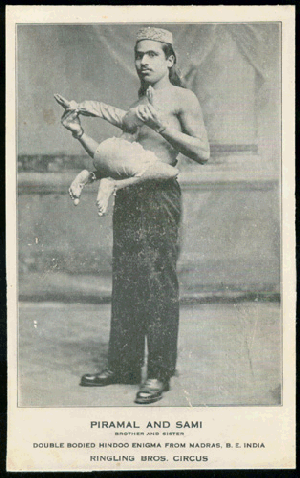
Moeschen points to the role that "sensation" played in separating the clinical photograph of medical monstrosity from the "freak portrait", evoking perhaps a distinction between the sensational props and posing of the visual construction of freakery with the potentially sensualised medical photographs which are marked by their nudity in order to reveal the anomalous body more fully to the viewer.

The article focuses on what Moeschen calls the "performative trace," which she sees as characterising the construction of both medical and sensational photographs of individuals with extraordinary bodies, creating "an alternate frame around these subjects that explicitly signals the perceptual and cognitive apparatuses ascribed to performance." She notes that
"The performative trace becomes another presentational "mode" employed, ironically in the case of the medical profession, to disarm these unusual bodies, endowing them with a quality of the ephemeral that ultimately promotes uncritical fascination; it promotes a kind of fetishistic voyeurism and illicit titillation."
The instability which this theatrical element introduces into these photographs is, for Moeschen, a deliberate strategy on the part of both medical and sideshow photographers to manipulate the "cultural and ideological value" of their subjects.

Wednesday, 26 October 2011

A Grotesque Aesthetic? The Anatomia Collection

Joseph Maclise, Pl.III "Dissection of the
Neck and Thorax, Heart and Blood Vessels"
Surgical Anatomy (1856).
We would like to draw your attention to an absolutely fabulous resource provided absolutely free by the University of Toronto - perfect for researchers in the medical humanities, or anyone with an admiration for exquisite anatomical art. Please indulge yourself and explore The Anatomia Collection: 4500 anatomical plates from the Thomas Fisher Rare Book Library, digitised and free to the public. The plates range in date from 1522-1867, and are fully indexed using medical subject headings (MeSH).

If you have perused our blog thoroughly, you might already have noticed that the gorgeous sketch depicting the face and skull of conjoined twins which we have selected as our header image is a section of a plate from Joseph Maclise's Surgical Anatomy (1856), all of the plates from which are available through the Anatomia Collection. This particular image was chosen not simply because of what it represented, but because Maclise's style itself, in this plate as throughout his body of work (pun fully intended), seems designed to elicit a highly sensual reaction.

His sketches often depict the hooks, strings, and instruments used to expose successive layers of flesh, vessels, and organs, remnants of the intrusion of medical probing which are typically erased from anatomical sketches. And also unlike many medical sketches, which hide the faces of their subjects, or else strip them of their identity, Maclise's "dissected figures", to quote the collection's description of the text, "seem almost life-like, with real faces, usually of young men with fair hair."

Joseph Maclise, Pl. 2 "Arteries, Veins, and
Nerves of the Thorax and Neck" in Richard Quain's
Anatomy of the Arteries of the Human Body (1844)
The description goes on to suggest that, "endowed with great dignity, the figures resemble the romantically noble heroic figures in his brother's paintings" (his brother being the artist Daniel Maclise). The assertion that Maclise endows his figures with dignity and romantic nobility is not necessarily untrue, but a scan through his work will reveal bodily contortions that seem more indicative of violent ecstasy, even torture, scattered throughout the romantic heroes. Amongst these evidently "life-like" figures also rises the gaunt, unavoidably lifeless face of one man, who simultaneously evokes images of decay, even of intense starvation.

Maclise's detailing of the feathered hair clinging to skin even as it is pulled apart to reveal each layer beneath, of the instruments that rip and tear as much as they slice, leaving ragged flaps as a grotesque frame, all of this casts a reflection of the dissected corpse on the page (or screen) onto the body of those observing it. As much as some images may evoke dignity and heroics, Maclise's overall style draws attention to a grim sensuality of dissection that is absent from many medical sketch. As he exposes the mystery of muscles and bones and blood vessels, his drawings render the subject/body monstrous; twisted, tortured, ecstatic, open bodies intimately tied to the living observer through an evocation of shared sensuality.

Thursday, 29 September 2011

H.R. Giger's Biomechanical Aesthetic

Passionate about Alien films? Fascinated by the sublime beauty of the Alien creatures? Interested in the complex interplay of the senses, transgressions and fetishist imagery present in this type of artwork? Then take a closer look at H.R. Giger, the fascinating artist whose works inspired the Alien films and explore his surreal world of shifting shapes, mechanics, fetishes and sensualised body parts.

H.R. Giger is an acclaimed Swiss surrealist artist, painter, sculptor, designer and interior architect whose art is usually described as 'Biomechanical aesthetic' defined as 'a dialectic between man and machine, representing a universe at once disturbing and sublime'. This universe represents a unique exploration into the human body, sexuality, (de)form(ation), polymorphous creatures and their ecstatic and sensual merging with technology. Fetishist tentacles, fetuses, orifices, ruptures, skeletal structures and various fluids constitute a part of this rich space of alterity and possibility.

The best resource for Giger's works is his official website, which offers a glimpe into his immense creativity, from articles and discussions on Alien films, images of Giger bars, sculptures, furniture, books, music and theatre. It also includes an informative biography revealing more about his life and art.

The website also offers a link to the Giger Museum, which aims to engage (or challenge) our senses more directly. Situated in the medieval Château St. Germain in Gruyères, Switzerland, it houses the greatest collection of his works from 1960s to today. If you are unable to visit this magical place, the elaborately and engagingly designed websites might serve as a compensation.
Finally, I warmly recommend the 'Short films' section of the Museum website, containing numerous tributes to Giger and featuring some of his brilliant works.

Feel free to share your impressions on this fascinating artist and his creations and how this may relate to your interests / conference ideas on any of our pages!