Communication and Construction of Monstrous Embodiment
June 15-16, 2012

Showing posts with label deformity. Show all posts

Monday, 19 March 2012

Conference Registration Now Live!

We are very excited to be able to announce that conference registration is now live! We are currently offering reduced advanced booking which will be available until 15 April, after which time the rates will revert to the standard prices. Of course we encourage you to take advantage of the advanced booking rates while you can!

You can register for the conference here. The preliminary conference programme is available here, and information regarding travel to and accommodation in Edinburgh can be found here.

Advanced booking rates (currently online) are as follows:
  • Advanced day-fee (unwaged) - £35
  • Advanced day-fee (waged) - £50
  • Advanced full-fee (unwaged) - £55
  • Advanced full-fee (waged) - £85
The standard booking rates are as follows:
  • Day-fee (unwaged) - £50
  • Day-fee (waged) - £65
  • Full-fee (unwaged) - £70
  • Full-fee (waged) - £100
Day-fee bookings will include access to the conference on the chosen day, as well as access to any additional events which may take place on that day. Please note that conference-related events on days for which you have not registered may carry a small separate fee.

Full-fee bookings include access to all conference events on both days as well as to the conference itself.

Information regarding such external conference events, including a conference dinner, will be made available nearer to the event itself. Please don't hesitate to contact us via e-mail at sdefconference(at)ed.ac.uk if you have any questions or concerns regarding registration.

Thursday, 8 March 2012

Preliminary Conference Programme

At long last, we are very excited to present a preliminary conference programme! Keep in mind that this is still quite early days, but this should give you some indication of the wonderful and exciting papers that will be presented come June.

Registration is also in the works and we very much hope to have that information for you within the week - sooner, if we have curried favour with one assortment of gods or another. There will be an advanced booking rate for those who choose to register by a certain deadline, and we of course encourage you to take advantage of that opportunity if you are able. There will also be reduced rates for unwaged participants, and day rates.

We would like to point out that the monster workshop and film night events are also still in the organisational stage, so the timing may change as things develop. We will post more details as things solidify. If you register for the conference on that date or for both days, you will be automatically able to attend both or either event; there may be an additional small fee for anyone not registered for that date.

We would also like to take this opportunity to thank everyone who submitted a proposal for the conference. It's difficult to really express how many truly fantastic papers we were sent, and how difficult it was to make decisions when constructing our panel sessions. We hope that as many of you as possible are able to still attend the conference, because if anything the quality and quantity of the proposals we received is an indication of the kind of exciting, innovative, and brilliant scholarship is being undertaken in this area at the moment, and we hope that you are able to come and participate in what will no doubt be a weekend of stunning academic ideas and discussion.

To that end, since we are aware that Edinburgh in June tends to be quite a bustling city, with quite a tourist influx, we have included a new page with details of accommodation ideas and travel details which you can find here, or at the top of the page under the "Coming to Edinburgh" tab. We hope this proves helpful, and that we can meet all of you in a few short months!

Monday, 5 March 2012

Monstrosity of the "Flesh" - Diederik Klomberg

By way of apology for our continued silence this month, we would like to make a peace offering in the form of a stunning piece of film art by Netherlands-based Diederik Klomberg: Flesh. For more of Klomberg's work, visit his website.

This 8-min short film offers what almost feels like a complete sensual envelopment, the soundtrack alone evoking a sensation perhaps akin to being bathed in amniotic fluid. The womb-like audio experience is paired alongside a mesmerising transformation of flesh as clitoris becomes ear, becomes bellybutton, becomes nipple. The film is a seamless mutation of the body in which folds, crevices, orifices, and unbroken skin melt into one another with a recklessness abandonment of the traditions of human form.

Flesh is a cinematic creation of the monstrous body in pieces, the body that is always already in the process of becoming both itself and its fleshly other. Each dissected, high definition pound of flesh becomes as alien as the Elephant Man's tumorous excess, or one of H.G. Geiger's biomechanical creatures. Each image is carved out of the healthy body to take on a life of its own; the breathing, pulsing soundtrack is not that of the body in-toto, but of a new, foreign body that quivers and grows as sphincters expand and an expanse of smooth skin crumples into canyons.

Since we are in the process of setting up registration and putting together a preliminary conference schedule, updates may be few and far between yet (although we hope to see a change in that pattern soon). Until then, treat yourself for about 8 minutes. There's really nothing quite like getting lost in a rolling tide of flesh and finding yourself confronted with the glorious monstrosity of a perfectly normal nostril.

Tuesday, 31 January 2012

"Freaky" terminology in Google's Ngram Viewer

Just a short post today about something that one of the conference organisers has been playing around with in liu of facing actual work. If you've encountered Google's Ngram viewer before then perhaps you have already thought to input the various words typically associated with the extraordinary body throughout history to see what you get. If not, then we'd like to share the following:

This graph represents the use of different terminology over time (from 1700 - 2000) as found in Google Books' digitized collection (click on the image for the full size, click on the in-text link for the details of search criteria or to run your own).


Breaking that down into labels which might, historically, have been associated with, or at least which now tend to be associated with historical/cultural conceptions of, extraordinary bodies - namely "monstrous," "deformed," "disabled," and "freak" - suggests some surprising trends in usage.


Below are a series of related breakdowns.

Wednesday, 25 January 2012

Call for Papers Extension

We have been incredibly blessed to receive a wealth of truly fascinating paper proposals over the last two and a half months. However, we must admit that when it comes to examples of academic brilliance, we are greedy, and so to maximise the number of proposals that we get to pour over, we have decided to extend the deadline for the call for papers to 16 February 2012.

"Sirenomelius, front and rear view", Human Monstrosities,
Hirst and Piersol (1893). Wellcome Library Collection.
We would like to take this opportunity to encourage everyone who reads the blog, has submitted a proposal, or follows us on Facebook or Twitter to pass the word along to anyone else who might be interested - they now have an extra two weeks to work on an abstract!

As before, abstracts should be submitted to sdefconference@ed.ac.uk, and the full call for papers can be found here. We also have a page devoted to outlining specific strands of discussion that we hope to develop - here. Even if you are unable to submit a proposal or attend the conference, we encourage you to contact us or continue following the blog updates as it is our long-term goal to link this wide-reaching community of researchers together by mailing lists and other means once the conference itself has passed.

For the time being, we very much look forward to yet more brilliant paper proposals in the coming weeks!

Thursday, 22 December 2011

Conjoined Twins in the News

This post isn't strictly tied to the theme of sensualising deformity, but given the extraordinary nature of the case and the time of year I felt that it warranted sharing. A pair of conjoined twins of the most rare degree, dicephalic parapagus, where two fully formed heads share a single body, including internal organs, have been born in Brazil.

The amazing thing about this is the fact that both the babies and the mother are alive and, we can assume, healthy. Obviously whether their condition will impact on their development remains to be seen, but at the moment it is simply wonderful that these two boys have survived to term and have been born without any apparent complications.

Perhaps the more disturbing note here is the article's insistent emphasis on separation, which has arisen in spite of the fact that doctors admit it to be impossible; separation in this instance would be "removal", selection one of the children to deliberately kill. That the conversation is taking place despite both twins exhibiting normal brain function and with no visible threat posed by one twin to the health and survival of the other is somewhat unsettling to say the least, but not surprising. To what degree does the assumption that separation is a given play in to legitimate medical concerns, and to what degree does it reflect the same anxieties of human form and human subjectivity which have always plagued conjoined twins?

Today, however, with the twins born only a few days before Christmas and Hanukkah, and right in the midst of the winter holiday season, we'd just like to wish them, and you, all our best. 

Sunday, 27 November 2011

Holiday Blog Break in December

We're not sure about you but we are certainly shocked to find that November is almost over already! Due to the usual winter holiday madness, we're sorry to say that we won't be able to maintain our usual blog post schedule. There will therefore be fewer posts throughout December and early January, especially around Christmas/New Years Eve. Hopefully you won't really notice because you will all be too busy having a wonderful holiday season yourselves!

However, by mid-January we will be back to our three-posts-a-week(ish) schedule, and I'm sure we will have many new articles, films, and online finds to share. Just don't forget about us completely - if we find anything fantastic or have any exciting news over the holidays we'll be sure to pull ourselves away from the mulled wine long enough to keep you in the loop!

Just a reminder that the deadline for paper abstracts is 31 January 2012, and that we will continue to reply to all submissions and queries (though you might see a slower response time). Once the deadline has passed and we have put together a schedule, we can look at posting specific information about fees, registration, travel, accommodation, and the like. So keep watching this space!

Once again, we are so grateful to have received such a wonderful reception of our conference, and such fantastic support all around! Thank you all for your interest and your kind words. Although it's still well in advance we'd like to wish you all a fantastic (and fantastically grotesque) holiday season and a wonderful new year!

Thursday, 24 November 2011

Sensuality as Disability - Victorians and Precocious Puberty

Since this week (22 November to be precise) marked the start of Disability History Month here in the UK, we thought that it was a  good time to draw your attention to a special issue of Nineteenth-Century Gender Studies from 2008, which explores the subject of "Critical Transformations: Disability and the Body in Nineteenth-Century Britain". Best of all, the issue, guest edited by Mark Mossman and Martha Stoddard-Holmes, is available free online in full.

Pieter Paaw, "Skeleton and Skull of a
Child." (1633), © University of Toronto
Library, 2003 
The journal offers a number of interesting articles exploring the intersection of gender and disability, such as Joyce L. Huff's "The Domesticated Monster: Freakishness and Disability in Fitz-James O'Brien's 'What Was It?'". Yet what is perhaps most interesting within the context of this conference (and this blog) is the inclusion of M. Jeanne Peterson's "Precocious Puberty and the Victorian Medical Gaze".

Peterson's article considers the responses on the part of Victorian medical reports to cases of precocious puberty and the way that they were tied to anxieties surrounding conceptions of gender, bodily normalcy, even the state of childhood itself. In so doing, she demonstrates, to quote Mossman and Stoddard-Holmes's introduction to the issue, "the fecundity of visual and structural disruptions of “normal” masculinity and femininity for narratives of pathology and normalcy." The introduction goes on to note that the article
"work[s] on the continuum on which the normal and the extraordinary both reside, noting the various points (and convergences) of discomfort, apprehension, attraction, and wonder these “extraordinary cases” produce"
In consciously choosing to place early-onset puberty within the discourse of disability, Peterson acknowledges that her decision may raise some questions, given that,
"precocious puberty would seem more a case of early ability rather than disability. But early puberty can also be understood as deviance, as straying from norms of bodily development. In the phenomena of early puberty doctors found amazement, desire, and dread."
In Peterson's study, then, the precocious development of physical markers of puberty, those undeniable indicators of the body's eroticism, its sensuality, become in and of themselves an illustration of disability. This definition of the preciously pubescent body would seem to bind Victorian constructions of disability, of exceptional bodies, to the sensual body in a way which is often overlooked. Sensuality here stands at the very core of disability, in stark contrast to a traditional conception in which the senses,  if not deliberately removed, are at the very least forgotten.

Tuesday, 15 November 2011

A Monster Observatory

One of our keynotes, Jeffrey Jerome Cohen, shared this fantastic link with us via his Twitter account, and we wanted to pass it along to our readers as well (share and share alike - it's a good motto).

With a name like A Monster Observatory and a tagline that runs "Cultural Teratology: Freaks, Monsters, the Grotesque", it should be pretty clear why we've taken an interest in this blog. However, if you needed convincing, we would refer you to the most recent post as of today, "Thinking About Monster Theory (Seven Theses)" - ten points if you can guess what it is about.

The site is managed by Dr Ian McCormick, and so far features a wealth of posts on mangled torsos, disability and the fourth plinth, and conjoined twins amongst other topics - in other words, every fascinating aspect of monstrosity, disability, and the grotesque body. If you're reading this blog, then A Monster Observatory probably deserves a spot on your bookmarks toolbar.

We'd also like to take this opportunity to remind everyone that we do acknowledge all inquiries and submissions, so if you have sent in a proposal or a question and haven't heard back, do get in touch. Likewise if you think there's something that our blog readers might find interesting or useful - articles, books (ideally available online), art or museum exhibitions, other blogs, even other conferences. You can send it our way via e-mail, Facebook, or Twitter (all information on the sidebar to your right). Pick your poison - we'd love to hear from you on any platform!

Tuesday, 8 November 2011

Code of the Freaks: forthcoming feature-length documentary

We were quite interested to hear about the upcoming film, Code of the Freaks. The feature-length documentary being developed by a group of film-makers based in Chigago aims to explore the depiction and construction of disability in Hollywood movies. Their website sets out the film as "an irreverent project" seeking to "stimulate critical discussion among diverse movie lovers. Tracing themes of representation from the 1920's to the present, we examine how movie images shape the public's understanding of disabled people":
Production still from Code of Freaks
"Audiences have internalized these coded images. Their narratives are ultimately projected onto disabled people in everyday life. It’s hard to find a disabled person who doesn’t have an absurdly ridiculous story about experiences with total strangers while simply walking down the street. These experiences to a great extent mirror what the public learns about disability through movies.
Our goal is to produce a feature-length documentary that will deconstruct, lampoon, and critique uses of the disabled character in film... Our process involves conducting these discussions with diverse disabled and non-disabled audiences to learn just how images of disability shape the social consciousness of disability."
The project also involves several events, public discussions organised around themes illustrated by Hollywood film montages cut with critical questions. Each month, the project's blog will feature a clip about a selection of films, and a trailer is already available online.

The film will no doubt offer a fascinating exploration into the larger cultural representation of disability as well as the Hollywood depictions, and hopefully will raise some discussion about the mutual influence that the two have on historical and contemporary constructions of disabled bodies. We would be especially interested to consider what role the sensualisation/eroticisation of extraordinary bodies might play in these filmed representations, if at all, and its significance.

Saturday, 29 October 2011

A Hallowe'en Treat: Surgeon's Hall Museum, Edinburgh

If you happen to be in the Edinburgh area this weekend, we recommend that you stop in to the Surgeon's Hall Museum to explore their fantastic collections and exhibits. It is their last open weekend this year, which is appropriate, since today and tomorrow are potentially the best possible days for exploring an exhibit about pathological anatomy, or the history of surgery, or Sherlock Holmes and his real-life counterpart, Charles Bell. They will still be open during the week, which means you are also welcome to visit on Hallowe'en itself. The museum is open from 12-4 Monday to Friday, and the weekend openings should start again in April.

The Surgeon's Hall Museum, Edinburgh
The Surgeon's Hall Museum also runs many special events and lectures in the stunning William Playfair building, so if you are local or planning a trip to the area, you might consider exploring their website to see whether they have anything exciting coming up (recent examples include the Pathology: A Day in Medical Detection event in October, while November and December feature tours on the history of medicine pre-anaesthesia and a talk on Scottish anatomists). You can also follow them on Twitter for updates and some fantastic links about the history of medicine.

If you aren't in Edinburgh, that doesn't mean you can't partake of the fun: come to the conference in June where we will be organising an opportunity to explore this amazing museum.

Have a deliciously monstrous Hallowe'en!

Wednesday, 26 October 2011

A Grotesque Aesthetic? The Anatomia Collection

Joseph Maclise, Pl.III "Dissection of the
Neck and Thorax, Heart and Blood Vessels"
Surgical Anatomy (1856).
We would like to draw your attention to an absolutely fabulous resource provided absolutely free by the University of Toronto - perfect for researchers in the medical humanities, or anyone with an admiration for exquisite anatomical art. Please indulge yourself and explore The Anatomia Collection: 4500 anatomical plates from the Thomas Fisher Rare Book Library, digitised and free to the public. The plates range in date from 1522-1867, and are fully indexed using medical subject headings (MeSH).

If you have perused our blog thoroughly, you might already have noticed that the gorgeous sketch depicting the face and skull of conjoined twins which we have selected as our header image is a section of a plate from Joseph Maclise's Surgical Anatomy (1856), all of the plates from which are available through the Anatomia Collection. This particular image was chosen not simply because of what it represented, but because Maclise's style itself, in this plate as throughout his body of work (pun fully intended), seems designed to elicit a highly sensual reaction.

His sketches often depict the hooks, strings, and instruments used to expose successive layers of flesh, vessels, and organs, remnants of the intrusion of medical probing which are typically erased from anatomical sketches. And also unlike many medical sketches, which hide the faces of their subjects, or else strip them of their identity, Maclise's "dissected figures", to quote the collection's description of the text, "seem almost life-like, with real faces, usually of young men with fair hair."

Joseph Maclise, Pl. 2 "Arteries, Veins, and
Nerves of the Thorax and Neck" in Richard Quain's
Anatomy of the Arteries of the Human Body (1844)
The description goes on to suggest that, "endowed with great dignity, the figures resemble the romantically noble heroic figures in his brother's paintings" (his brother being the artist Daniel Maclise). The assertion that Maclise endows his figures with dignity and romantic nobility is not necessarily untrue, but a scan through his work will reveal bodily contortions that seem more indicative of violent ecstasy, even torture, scattered throughout the romantic heroes. Amongst these evidently "life-like" figures also rises the gaunt, unavoidably lifeless face of one man, who simultaneously evokes images of decay, even of intense starvation.

Maclise's detailing of the feathered hair clinging to skin even as it is pulled apart to reveal each layer beneath, of the instruments that rip and tear as much as they slice, leaving ragged flaps as a grotesque frame, all of this casts a reflection of the dissected corpse on the page (or screen) onto the body of those observing it. As much as some images may evoke dignity and heroics, Maclise's overall style draws attention to a grim sensuality of dissection that is absent from many medical sketch. As he exposes the mystery of muscles and bones and blood vessels, his drawings render the subject/body monstrous; twisted, tortured, ecstatic, open bodies intimately tied to the living observer through an evocation of shared sensuality.

Thursday, 20 October 2011

The Monster in the Machine

Those of you focusing on the Early Modern period may already be familiar with Zakiya Hanafi's The Monster in the Machine: Magic, Medicine, and the Marvelous in the Time of the Scientific Revolution (Duke University Press, 2000), but for those of you who aren't, you may find it interesting. Hanafi explores the evolution of sacred monsters into monstrous automata in early modern Italy, but her discussion touches on a conceptualisation of monstrosity that spreads far beyond these regional and chronological specifics. Particularly interesting is her discussion of the relationship between the monstrous body and the monstrous automaton, in which both rely on an understanding of monstrosity not as, to use her own words, "any specific thing", but as "a category that becomes constituted in different ways according to different cultural and historical contexts".

Henri Maillardet's Automaton at
The Franklin Institute, Philadelphia
The discussion of a historical relationship between monstrum and automaton raises interesting questions regarding notions of the sensualised or de-sensualised monster, especially regarding Hanafi's description of mechanised monstrosity itself:
"What makes an automaton monstrous is not the arrangement of its parts (although the automaton is often formed to represent a monster, a highly significant convergence). That is to say, that disposition of its limbs is not what makes it rare and extraordinary; that is not what makes it a monstrum. Rather, it is the fact that matter formed by artificial means and moving of its own volition would seem to be endowed with spirit... The horror and fear provoked by appearances in nature of monstrous births moved over into the horror and fear provoked by our own artificial creations"
Such an idea of the monstrous automaton seems inherently disembodied and yet intrinsically tied to a kind of artificial embodiment. Interestingly, it also seems to cast out once again the role of the senses in not only the reaction to the monstrous, but also in the conceptualisation of monstrosity. Although it may not necessarily have been an intentional directive of the text, in exploring the bonds between the development of monsters and the scientific revolution in Italy Hanafi draws attention to a sterilisation of the monstrous which is characteristic of many categories of monstrosity across cultural and historical boundaries.

Thursday, 13 October 2011

Rhetoric of Monstrosity

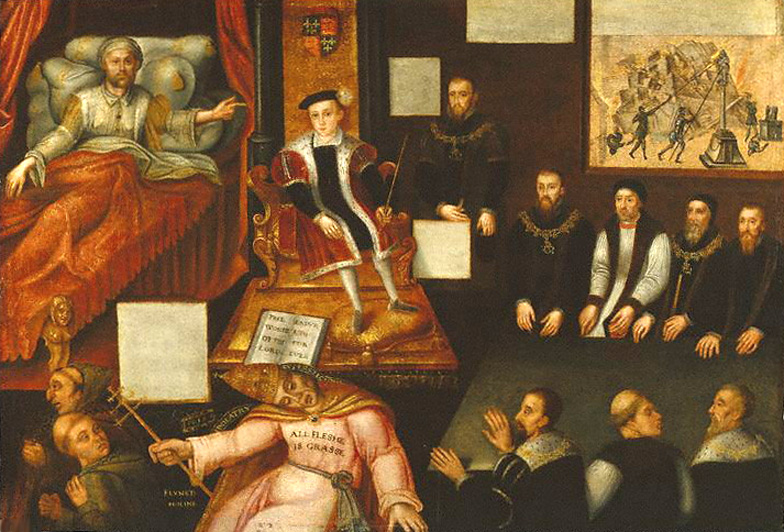
Kathryn M. Brammall's article 'Monstrous Metamorphosis: Nature, Morality, and the Rhetoric of Monstrosity in Tudor England' (usually accessible through various institutions / universities) offers an interesting analysis of the rhetoric of monstrosity and reasons behind a surge of interest in monsters and monstrous births emerging in mid-Tudor England. Brammall highlights the importance of early modern attitudes towards monsters themselves, 'precisely because they materialize in so many different contexts'. She particularly focuses on mid-Tudor England, where the social, political and religious challenges were ''partially responsible for the increasing interest in monsters'', resulting in numerous tracts detailing monstrous births. Furthermore, Brammell offers a succinct analysis of those tracts, their veracity and the complex political and religious context of such accounts. Monstrous births were freuqently seen as signs of God, resulting in numerous interpretations and speculation. Brammell highlight the example of Ponet who interpreted monsters by connecting them to problems in contemporary England:

The first monster, a conjoined twin with two heads and two partially joined bodies, was in Ponet's estimation a symbol of the succession of one legitimate ruler, Edward VI, by two distinct governors. It was possible to interpret the division in two ways: as that between Catholic and Protestant or that between English and Spanish, whose respective representatives were Mary and Philip. Either interpretation was acceptable to Ponet, since each served his main purpose: the denunciation of the queen. The confusion caused by both the return to Rome and the Spanish marriage -Ponet suggested, resulted in a divided populace, one in which two parts were thrust together without reason or justice. The division inevitably emasculated the body politic.

Apart from Ponet's interpretation, Brammell also focuses on ballads describing various monsters, where the authors ''interpreted the individual physical deformities in terms that focus the reader's attention on universal sin'', firmly rooted in the reality of Tudor England.
Ultimately, writers of this period relied heavily on the rhetoric of monstrosity and images of monstrous births to confront what they considered to be sinful and corrupt in their society. Transgressing and blurring boundaries between inner and outer, physical and psychical ''deformity'', the period's writings on monsters remain a fascinating and contradictory field of inquiry.

Wednesday, 21 September 2011

Jeffrey Jerome Cohen, "Giants"

Julius Koch, Le Geant Constantin
Image courtesy of TheTallestMan.com
As you can probably imagine, we are looking forward to the forthcoming Ashgate Encyclopedia of Literary and Cinematic Monsters, ed. Jeffrey Weinstock, with great anticipation (it's hardly a stretch of the imagination to say that if you're reading this blog, you are too, and if you weren't before, you most definitely are now. Or at least you should be). To be totally honest, we simply cannot wait for it to be published.

Time travel was attempted (and subsequently abandoned), things were learned that cannot be unlearned, and our respective psyches were threatened with total destruction. As a result, we had no choice but to resign ourselves to the doleful realisation that, like mere mortals, we would have to wait.

But that wait has been made less torturous by Jeffrey Jerome Cohen (who, just a small reminder, will be flying all the way from Washington D.C. to Edinburgh, Scotland to be a keynote at our conference along with Peter Hutchings and Margrit Shildrick). On the In the Middle blog, he was ever so kind last month to post a draft of his entry on giants, to which we now direct your attention:
The giant pervades every level of society, from popular culture and folklore to self-consciously artistic literature and scholarly discourse. With some notable exceptions, the giant is strongly gendered male. He often figures the masculine body out of control, demarcating a cultural boundary not to be traversed. The giant is foundational. The world may have been created from the body of a giant, as in Norse fable; or the body of the earth may spawn giants, as in classical tradition. He is so elemental that humanity cannot escape his abiding presence.
Keep an eye out for the encyclopaedia itself - definitely going to be a good book to have on the shelf. 

Sunday, 11 September 2011

Cute & Creepy Exhibition in Florida

Sadly for us, all of the organisers of the Sensualising Deformity conference are based in Edinburgh, which means we cannot attend the absolutely fantastic and grotesque Cute and Creepy exhibition at the Museum of Fine Arts at Florida State University in Tallahassee. But we can help encourage others to attend in our stead, and hope that they will bring back tales of their creepy experiences. The exhibit will be held between 14 October and 20 November of this year, so there's plenty of time yet to plan your trip; perhaps your family or friends might enjoy a trip to Disney World while you nip off for some monstrous pop surrealism?

The site's home page offers different examples of the work, or the kind of work, that will be offered at the exhibit, and based on that alone there is no question that it would be of interest to this conference and anyone reading the blog, but as if to ensure no further doubt, curator Carrie Ann Baade writes,
To see beauty in the carnivalesque or macabre, in freaks and in monsters, is a matter of aesthetics. Most of us can agree on the artistic value of a Monet or Titian but this work is for a daring audience, an audience open to exploring the strange beauty and the ecstasy inherent in our culture's aversions.
Travis Louis, The Curse of the Goat, 2006.
There is something that makes us uneasy when confronted by the weird or the unusual. Those who can appreciate both have come to anticipate and enjoy unexpected sensations. Work of this nature is not going to be an underground movement any longer: the grotesque is going mainstream.
The website also offers a tantalising excerpt of Nancy E. Hightower's essay "Revelatory Monsters: Deconstructive Hybrids, the Grotesque, and Pop Surrealism" that is included in the exhibition catalogue, which is worth quoting in full:
We need monsters in our lives.
We like to fear them, to run hiding under the covers or clenching a lover's arm until the monster is destroyed or banished to far off lands. they are wonderful like that, refusing to ever completely disappear from our lives, affording us the opportunity for self-introspection if we take a moment to recognize that monsters don’t die because they are essentially us(Cohen 5). Once they are eradicated from our cultural memory, we go, too. And that monstrous, wondrous body is at the heart of the grotesque. From the playful grotteschiunearthed in the Domus Aurea to demons of the illuminated manuscripts that overflowed from the margins onto the actual text, the monstrous body has always threatened what our culture has desired to contain (or perhaps more accurately, trapped, vetted, and fixed to incorporate whatever impossible standards it has set up to differentiate us from them). But the monstrous body is also prophetic in nature.
Jeffrey Jerome Cohen argues that as a “construct and a projection, the monster exists only to be read: the monstrum is etymologically ‘that which reveals’ that which warns…like a letter on the page, the monster signifies something other than itself”. What sets up this kind of fulcrum is society itself: “The too-precise laws of nature as set forth by science are gleefully violated in the freakish compilation of the monster's body. A mixed category, the monster resists any classification built on hierarchy or a merely binary opposition, demanding instead a ‘system’ allowing polyphony, mixed response (difference in sameness, repulsion in attraction), and resistance to integration…”. These kinds of juxtapositions are what form the definition of the grotesque.
Greg Simpkins, Knightengale, 2008.
Of course, with such passages accompanying the examples of art included on the home page of the site, monsterphiles who, like us, don't live anywhere near the exhibition will be working out calculations in the vain hope that a trip to Florida this autumn might be within their budget (we feel your pain). But if you happen to be so lucky as to be in Florida, or close enough for a visit, we highly recommend visiting the exhibition.

If not, perhaps you will have to do as we are doing and wistfully pass on the information to any fortune-favoured friends you might have who could attend! In the meantime, console yourself, perhaps, with a closer look at the artists involved, whose work is engaging with monstrosity in such sensational ways.

Friday, 9 September 2011

British Medical Journal Teratological Memoranda

Images courtesy of the BMJ Publishing Group,
BMJ 1889, June 8; 1(1484): 1288–1289.
Those of you interested in teratology - 19th century especially - will probably already be quite familiar with the British Medical Journal's Teratological Memoranda, but if you haven't had a spare hour or two to browse through their older archives looking for reports of "human monsters", we would like to direct you to articles such as this, which describes the birth of three monstrous infants, a pair of conjoined twins and a limbless child whose birth is attributed to the mother having "seen a fish she never thought existed". Perhaps the most interesting thing featured in both reports is the woodcut included with each, that of the conjoined twins especially. 

In placing the figure of the twins against a black background, the gap between them and the band of flesh which binds them together are thrown into sharp relief; their faces seem closer, within kissing distance, because of the space between them. Their position seems transformed into a sensual one by the intense nearness, which is itself born of that crucial gap. Contrasted with the harshly tactile description given by the author of his involvement in their birth, focused on his probing hands and fingers, in this image it is the lack of contact which is the more sensuous.

The image of the limbless child, on the other hand, is memorable for the almost wistful expression depicted on the baby's face, its humanity over emphasised as if to counter the anomalous form below.


Wednesday, 7 September 2011

Audio Teratology

In the interest of inspiring discussion and debate, we draw your attention to some samples from The Teratologist music project, which released its third album, Cabinet of Curiosities Parts III & IV, this  June.

Descriptions of the albums include "an amalgamation of musique concrète, electroacoustic, harsh ambient and drone", "deep textures of acoustic and electronic composition", and "a[n] esoteric feeling generally stimulated by ritual music" - raising questions of how such industrial, electric, "harsh" music can be integrated with a project title that gestures towards a phenomenon that is more often soft, flesh-like, wrapped up within a body that is open or opening, moist, textured, palpable.

The samples do not pander to the senses, but deliberately offend them, evoking sensations that stand on the edge of paranoia, a rejection of sound which is an intrusion upon the flesh. The disembodied music forces a bodily response, tying the internal with the unnatural, external stimulus - eerily reminiscent of the teratologist himself, a figure of intrusion, of harsh metallic instruments who sought to inflict pain in his study of the monstrous body. In encompassing the discipline of teratology within a sensuous experience, what does such a project do to the monstrous specimen in the cabinet of curiosities itself, the figure which lies behind the music, which is denied any mention but remains an intrinsic part of it?

Questions, comments, disagreements, re-articulations - anything short of outright insults - are encouraged in the comments section.


Thursday, 18 August 2011

The Sensualising Deformity Blog

One of the long-term goals of the Sensualising Deformity conference is to bring together scholars and students around the world and across disciplines who share an interest in deformity, monstrosity, or freakery, and to develop a network that connects them together.

This blog is a central part of that aim, offering links to all things related to the conference themes, be they articles, seminars, exhibitions, websites, films, or general miscellanea. We also hope to post calls for papers and contributions for other conferences or collections that are being organised in the field.

For those who may not, for whatever reason, be able to attend the conference in June, we hope the blog will ensure that you are still welcomed as part of a network of like-minded individuals, and that you will find here a source of knowledge and ideas as fascinating as the conference itself!