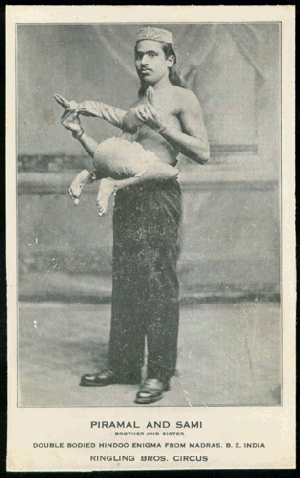
This post is going to be a two-for-one deal, to make up for the fact that we've still not gotten quite back into our usual routine of 2-3 posts each week.
First, we would like to draw your attention to a project based in San Francisco but which is thankfully reaching its way across America and the Atlantic - Sins Invalid. The project itself is a performance-based initiative which "incubates and celebrates artists with disabilities," according to the website's description, "centralizing artists of color and queer and gender-variant artists as communities who have been historically marginalized from social discourse."
What is even more exciting is that they are currently in the final stages of production on a 41 min film that reflects the project itself: Sins Invalid: An Unshamed Claim to Beauty. The film is designed to, as they phrase it, "serve as an entryway into the absurdly taboo topic of sexuality and disability," a notion which pertains particularly to the aims of the conference, so naturally we are very excited to see the final result! The project is still looking for funding through a kickstarter campaign in order to complete the last details of production, and they offer incentives depending on your donation. As with any Kickstarter fundraising scheme, your donation only goes through if they reach their goal, and we certainly hope they do, so please check out their campaign and their website, and if you're lucky enough to be in the area, seek out one of their performances!
The second piece of news we have is more relevant for those of you in the Edinburgh area (or who might be in the Edinburgh area at some point). The Surgeon's Hall Museum will be open 12-4pm on weekends once more starting 31 March and lasting all the way until October. We can very much vouch for the quality of the museum, and it is well worth a visit. It could be a fantastic Saturday day-trip; not enough day-trips feature pathological anatomical specimens, and the team behind Sensualising Deformity thinks it's time to change that!
Communication and Construction of Monstrous Embodiment
June 15-16, 2012
Showing posts with label sexuality. Show all posts
Sunday, 29 January 2012
Wednesday, 18 January 2012
Freakery and "Aesthetic Traces"
If you happen to be interested in "freaks," freakery, and its relationship to nineteenth-century medical "monsters", we'd like to draw your attention to a fascinating article published in 2005 in the Disability Studies Quarterly, Sheila Moeschen's "Aesthetic Traces in Unlikely Places: Re-visioning the Freak in 19th-Century American Photography". The article, which is open access, offers an intriguing reading of the role that photography played in the creation and presentation of extraordinary bodies in the nineteenth century; Moeschen denies that fictive division which might separate the objective medical photograph from its public side-show counterpart, typically deemed to be more deliberately titillating. Instead, she suggests,
The article focuses on what Moeschen calls the "performative trace," which she sees as characterising the construction of both medical and sensational photographs of individuals with extraordinary bodies, creating "an alternate frame around these subjects that explicitly signals the perceptual and cognitive apparatuses ascribed to performance." She notes that
"The two traditions form a reciprocal relationship that illuminates their representational and political imbrications. The historical persistence to delineate between a medical and artistic "aesthetic" reveals a disconcerting bias towards privileging the power and credibility of the empirical realm over the artistic."Moeschen points to the role that "sensation" played in separating the clinical photograph of medical monstrosity from the "freak portrait", evoking perhaps a distinction between the sensational props and posing of the visual construction of freakery with the potentially sensualised medical photographs which are marked by their nudity in order to reveal the anomalous body more fully to the viewer.
The article focuses on what Moeschen calls the "performative trace," which she sees as characterising the construction of both medical and sensational photographs of individuals with extraordinary bodies, creating "an alternate frame around these subjects that explicitly signals the perceptual and cognitive apparatuses ascribed to performance." She notes that
"The performative trace becomes another presentational "mode" employed, ironically in the case of the medical profession, to disarm these unusual bodies, endowing them with a quality of the ephemeral that ultimately promotes uncritical fascination; it promotes a kind of fetishistic voyeurism and illicit titillation."The instability which this theatrical element introduces into these photographs is, for Moeschen, a deliberate strategy on the part of both medical and sideshow photographers to manipulate the "cultural and ideological value" of their subjects.
Thursday, 24 November 2011
Sensuality as Disability - Victorians and Precocious Puberty
Since this week (22 November to be precise) marked the start of Disability History Month here in the UK, we thought that it was a good time to draw your attention to a special issue of Nineteenth-Century Gender Studies from 2008, which explores the subject of "Critical Transformations: Disability and the Body in Nineteenth-Century Britain". Best of all, the issue, guest edited by Mark Mossman and Martha Stoddard-Holmes, is available free online in full.
The journal offers a number of interesting articles exploring the intersection of gender and disability, such as Joyce L. Huff's "The Domesticated Monster: Freakishness and Disability in Fitz-James O'Brien's 'What Was It?'". Yet what is perhaps most interesting within the context of this conference (and this blog) is the inclusion of M. Jeanne Peterson's "Precocious Puberty and the Victorian Medical Gaze".
Peterson's article considers the responses on the part of Victorian medical reports to cases of precocious puberty and the way that they were tied to anxieties surrounding conceptions of gender, bodily normalcy, even the state of childhood itself. In so doing, she demonstrates, to quote Mossman and Stoddard-Holmes's introduction to the issue, "the fecundity of visual and structural disruptions of “normal” masculinity and femininity for narratives of pathology and normalcy." The introduction goes on to note that the article
| Pieter Paaw, "Skeleton and Skull of a Child." (1633), © University of Toronto Library, 2003 |
Peterson's article considers the responses on the part of Victorian medical reports to cases of precocious puberty and the way that they were tied to anxieties surrounding conceptions of gender, bodily normalcy, even the state of childhood itself. In so doing, she demonstrates, to quote Mossman and Stoddard-Holmes's introduction to the issue, "the fecundity of visual and structural disruptions of “normal” masculinity and femininity for narratives of pathology and normalcy." The introduction goes on to note that the article
"work[s] on the continuum on which the normal and the extraordinary both reside, noting the various points (and convergences) of discomfort, apprehension, attraction, and wonder these “extraordinary cases” produce"In consciously choosing to place early-onset puberty within the discourse of disability, Peterson acknowledges that her decision may raise some questions, given that,
"precocious puberty would seem more a case of early ability rather than disability. But early puberty can also be understood as deviance, as straying from norms of bodily development. In the phenomena of early puberty doctors found amazement, desire, and dread."In Peterson's study, then, the precocious development of physical markers of puberty, those undeniable indicators of the body's eroticism, its sensuality, become in and of themselves an illustration of disability. This definition of the preciously pubescent body would seem to bind Victorian constructions of disability, of exceptional bodies, to the sensual body in a way which is often overlooked. Sensuality here stands at the very core of disability, in stark contrast to a traditional conception in which the senses, if not deliberately removed, are at the very least forgotten.
Sunday, 18 September 2011
Constructing The Hottentot Venus
Those of you interested in nineteenth century freak shows and the complexities of exhibiting 'cultural otherness', or the (de)humanization of the 'freak' and / or 'specimen', will certainly come across the diverse and often conflicting views on Saartjie (or Sarah) Baartman also known as the Hottentot Venus.
Stripped of her cultural context, Baartman was exhibited as one of the most popular 'freaks' in the nineteenth century, whose body was exposed to curious viewers as a spectacle of 'cultural otherness'. Baartman was presented to viewers in a cage, dressed in a tight fitting costume which emphasized her distinctive shape. Her breasts, buttocks and hypertrophied genitalia became the nineteenth century symbol for excessive and deviant female sexuality and inspired numerous primitivist ideologies which equated her with an animal. This voyeuristic exhibiting of her body continued long after her death, resulting in numerous discourses on gender, sexuality, race, colonialism and ethnocentrism.

In case you have access to it, you might find useful Sander L. Gilman's influential and frequently quoted article entitled 'Black Bodies, White Bodies: Toward an Iconography of Female Sexuality in Late Nineteenth-Century Art, Medicine and Literature' (Critical Inquiry 12, Autumn 1985) where he explores the representations of individuals in art which is frequently 'iconographic' in character, in which specific individuals represent particular 'classes' of people, especially when they are perceived as 'the other' and different to 'Western white male' concepts of normality. In referring to the Hottentot Venus, the article provides an exploration of racial stereotypes and their relationship to constructions of deviant sexuality. More specifically, Gilman discusses the 19th century fascination with Baartman's overtly sexualized 'anomalous' body parts, explaining it in the following terms:
Sarah Baartman's sexual parts, her genitalia and her buttocks, serve as the central image for the black female throughout the nineteenth century. And the model of de Blainville's and Cuvier's descriptions, which center on the detailed presentation of the sexual parts of the black, dominates all medical description during the nineteenth century. To an extent, this reflects the general nineteenth-century understanding of female sexuality as pathological: the female genitalia were of interest partly as examples of the various pathologies. (...) Sarah Baartman's genitalia and buttocks summarized her essence for the nineteenth century observers, or, indeed, for the twentieth century one.
This fascination with her body parts and her subsequent treatment as a preserved specimen additionally commodified her body, constructing it as simply another item to be collected and displayed. Dehumanized in medical reports, dissected and once again exposed after death, her voice remained largely obscured.
Another interesting article which highlights the importance of contextualization is Sadiah Qureshi's article 'Displaying Sara Baartman, the 'Hottentot Venus' (History of Science, Vol.42, 2004) which points to the processes involved in Baartman's objectification, politicization, exhibition and preservation. By examining these processes, it is possible to new perspectives on her story as well as 'historicize her tale'. Considering Baartman's agency, Qureshi writes:
A significant factor is the lack of agency Baartman inevitably possesses in any retelling of her story, since all the surviving records are accounts of her, rather than diaries or letters from her. Consequently, it is precisely the difficulty in recovering her agency that makes her amenable to employment as a cipher, even her minimal presence being enough; unfortunately this only constitutes further to her dispossession.
In the end, what can we know of Baartman's person? It seems to be an ever-evolving pursuit: by exploring the construction of the 'Hottentot Venus', critically reflecting on numerous existing discourses surrounding her (the sea of publications and biographies) as well as and contextualizing Baartman's story, it is possible to open new perspectives (and questions) on the life and experiences of this remarkable woman, whose real name still remains - unknown.
Stripped of her cultural context, Baartman was exhibited as one of the most popular 'freaks' in the nineteenth century, whose body was exposed to curious viewers as a spectacle of 'cultural otherness'. Baartman was presented to viewers in a cage, dressed in a tight fitting costume which emphasized her distinctive shape. Her breasts, buttocks and hypertrophied genitalia became the nineteenth century symbol for excessive and deviant female sexuality and inspired numerous primitivist ideologies which equated her with an animal. This voyeuristic exhibiting of her body continued long after her death, resulting in numerous discourses on gender, sexuality, race, colonialism and ethnocentrism.

In case you have access to it, you might find useful Sander L. Gilman's influential and frequently quoted article entitled 'Black Bodies, White Bodies: Toward an Iconography of Female Sexuality in Late Nineteenth-Century Art, Medicine and Literature' (Critical Inquiry 12, Autumn 1985) where he explores the representations of individuals in art which is frequently 'iconographic' in character, in which specific individuals represent particular 'classes' of people, especially when they are perceived as 'the other' and different to 'Western white male' concepts of normality. In referring to the Hottentot Venus, the article provides an exploration of racial stereotypes and their relationship to constructions of deviant sexuality. More specifically, Gilman discusses the 19th century fascination with Baartman's overtly sexualized 'anomalous' body parts, explaining it in the following terms:
Sarah Baartman's sexual parts, her genitalia and her buttocks, serve as the central image for the black female throughout the nineteenth century. And the model of de Blainville's and Cuvier's descriptions, which center on the detailed presentation of the sexual parts of the black, dominates all medical description during the nineteenth century. To an extent, this reflects the general nineteenth-century understanding of female sexuality as pathological: the female genitalia were of interest partly as examples of the various pathologies. (...) Sarah Baartman's genitalia and buttocks summarized her essence for the nineteenth century observers, or, indeed, for the twentieth century one.
This fascination with her body parts and her subsequent treatment as a preserved specimen additionally commodified her body, constructing it as simply another item to be collected and displayed. Dehumanized in medical reports, dissected and once again exposed after death, her voice remained largely obscured.
Another interesting article which highlights the importance of contextualization is Sadiah Qureshi's article 'Displaying Sara Baartman, the 'Hottentot Venus' (History of Science, Vol.42, 2004) which points to the processes involved in Baartman's objectification, politicization, exhibition and preservation. By examining these processes, it is possible to new perspectives on her story as well as 'historicize her tale'. Considering Baartman's agency, Qureshi writes:
A significant factor is the lack of agency Baartman inevitably possesses in any retelling of her story, since all the surviving records are accounts of her, rather than diaries or letters from her. Consequently, it is precisely the difficulty in recovering her agency that makes her amenable to employment as a cipher, even her minimal presence being enough; unfortunately this only constitutes further to her dispossession.
In the end, what can we know of Baartman's person? It seems to be an ever-evolving pursuit: by exploring the construction of the 'Hottentot Venus', critically reflecting on numerous existing discourses surrounding her (the sea of publications and biographies) as well as and contextualizing Baartman's story, it is possible to open new perspectives (and questions) on the life and experiences of this remarkable woman, whose real name still remains - unknown.
Subscribe to:
Posts (Atom)