As excited as we are for the launch of our conference registration, we know that the level of interest the event has generated since September far exceeds the number of people who will be travelling to Edinburgh in June. While we hope to see as many of you at the conference as can make it, we also want to continue providing resources support for those of you who can't.
Which is why we are also excited to announce the publication of The Ashgate Research Companion to Monsters and the Monstrous, edited by Asa Simon Mittman. This sensational book looks to be a landmark release in the field of monster studies, and features essays by conference keynote Jeffrey Jerome Cohen (who brought the collection to our attention), as well as Patricia MacCormack, John Block Friedman, Jeffrey Andrew Weinstock, Dana Oswald, Debra Higgs Strickland, Karl Steel, and Peter J. Dendle.
Sufficiently weighty, both in mass and in content, from the looks of the table of contents and available excerpts, to justify the list price, there seems little doubt that the Companion will become a stable of monster researchers' libraries everywhere. In an emerging field of study, we can't help but gleefully imagine the shock and awe it will inspire in newly inducted students as it works its way into core course syllabi.
On a lighter, and more literary, note, we would also like to point out that this week marks the "12 Days of Monsters" on the Weird Fiction Review website. Posts by Jeff VanderMeer and Nancy Hightower have already touched on China MiƩville, and throughout the whole week Pretty Monsters, a novella by Kelly Link, is available, as is a free download of VanderMeer's own Monstrous Creatures collection. Well worth keeping an eye on as the week unfolds!
Of course, a reminder that registration, travel, and accommodation info can now be found on the "Fees and Information" page here.
Communication and Construction of Monstrous Embodiment
June 15-16, 2012
Showing posts with label transgression. Show all posts
Tuesday, 20 March 2012
Thursday, 24 November 2011
Sensuality as Disability - Victorians and Precocious Puberty
Since this week (22 November to be precise) marked the start of Disability History Month here in the UK, we thought that it was a good time to draw your attention to a special issue of Nineteenth-Century Gender Studies from 2008, which explores the subject of "Critical Transformations: Disability and the Body in Nineteenth-Century Britain". Best of all, the issue, guest edited by Mark Mossman and Martha Stoddard-Holmes, is available free online in full.
The journal offers a number of interesting articles exploring the intersection of gender and disability, such as Joyce L. Huff's "The Domesticated Monster: Freakishness and Disability in Fitz-James O'Brien's 'What Was It?'". Yet what is perhaps most interesting within the context of this conference (and this blog) is the inclusion of M. Jeanne Peterson's "Precocious Puberty and the Victorian Medical Gaze".
Peterson's article considers the responses on the part of Victorian medical reports to cases of precocious puberty and the way that they were tied to anxieties surrounding conceptions of gender, bodily normalcy, even the state of childhood itself. In so doing, she demonstrates, to quote Mossman and Stoddard-Holmes's introduction to the issue, "the fecundity of visual and structural disruptions of “normal” masculinity and femininity for narratives of pathology and normalcy." The introduction goes on to note that the article
| Pieter Paaw, "Skeleton and Skull of a Child." (1633), © University of Toronto Library, 2003 |
Peterson's article considers the responses on the part of Victorian medical reports to cases of precocious puberty and the way that they were tied to anxieties surrounding conceptions of gender, bodily normalcy, even the state of childhood itself. In so doing, she demonstrates, to quote Mossman and Stoddard-Holmes's introduction to the issue, "the fecundity of visual and structural disruptions of “normal” masculinity and femininity for narratives of pathology and normalcy." The introduction goes on to note that the article
"work[s] on the continuum on which the normal and the extraordinary both reside, noting the various points (and convergences) of discomfort, apprehension, attraction, and wonder these “extraordinary cases” produce"In consciously choosing to place early-onset puberty within the discourse of disability, Peterson acknowledges that her decision may raise some questions, given that,
"precocious puberty would seem more a case of early ability rather than disability. But early puberty can also be understood as deviance, as straying from norms of bodily development. In the phenomena of early puberty doctors found amazement, desire, and dread."In Peterson's study, then, the precocious development of physical markers of puberty, those undeniable indicators of the body's eroticism, its sensuality, become in and of themselves an illustration of disability. This definition of the preciously pubescent body would seem to bind Victorian constructions of disability, of exceptional bodies, to the sensual body in a way which is often overlooked. Sensuality here stands at the very core of disability, in stark contrast to a traditional conception in which the senses, if not deliberately removed, are at the very least forgotten.
Tuesday, 8 November 2011
Code of the Freaks: forthcoming feature-length documentary
We were quite interested to hear about the upcoming film, Code of the Freaks. The feature-length documentary being developed by a group of film-makers based in Chigago aims to explore the depiction and construction of disability in Hollywood movies. Their website sets out the film as "an irreverent project" seeking to "stimulate critical discussion among diverse movie lovers. Tracing themes of representation from the 1920's to the present, we examine how movie images shape the public's understanding of disabled people":
The film will no doubt offer a fascinating exploration into the larger cultural representation of disability as well as the Hollywood depictions, and hopefully will raise some discussion about the mutual influence that the two have on historical and contemporary constructions of disabled bodies. We would be especially interested to consider what role the sensualisation/eroticisation of extraordinary bodies might play in these filmed representations, if at all, and its significance.
![]() |
| Production still from Code of Freaks |
"Audiences have internalized these coded images. Their narratives are ultimately projected onto disabled people in everyday life. It’s hard to find a disabled person who doesn’t have an absurdly ridiculous story about experiences with total strangers while simply walking down the street. These experiences to a great extent mirror what the public learns about disability through movies.The project also involves several events, public discussions organised around themes illustrated by Hollywood film montages cut with critical questions. Each month, the project's blog will feature a clip about a selection of films, and a trailer is already available online.
Our goal is to produce a feature-length documentary that will deconstruct, lampoon, and critique uses of the disabled character in film... Our process involves conducting these discussions with diverse disabled and non-disabled audiences to learn just how images of disability shape the social consciousness of disability."
The film will no doubt offer a fascinating exploration into the larger cultural representation of disability as well as the Hollywood depictions, and hopefully will raise some discussion about the mutual influence that the two have on historical and contemporary constructions of disabled bodies. We would be especially interested to consider what role the sensualisation/eroticisation of extraordinary bodies might play in these filmed representations, if at all, and its significance.
Friday, 4 November 2011
Curious Pursuits Exhibition, Manchester
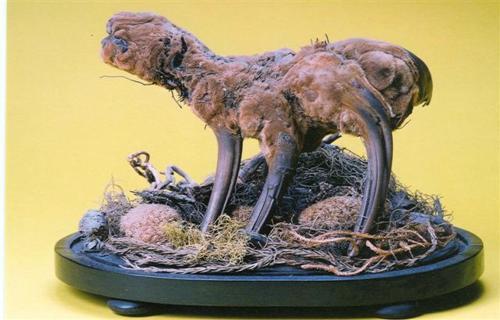
| Vegetable Lamb from The Museum of Garden History, London |
"Art Historian collective Porter & Jenkinson aim to showcase the best contemporary art of a curious and unusual nature. Through exploring the dark, strange and depraved themes of the Victorian era they curate exhibitions of works that respond directly to these ideas. They intend to bring to the foreground these forgotten aesthetics and to explore the responses and reactions in contemporary society."Porter & Jenkinson's first exhibition, Curious Pursuits, will be taking place from the 2-29th February 2012 at the Portico Library in Manchester, and they are still accepting submissions until 31 December if you happen to be of artistic skill. If you are not so lucky, it should still prove a fascinating exhibition, well worth a trip to Manchester if you're not based in the area.
If Manchester seems a bit far to go, then their website - while still relatively new - is already exhibiting some interesting content, and we look forward to seeing what other finds they will post next.
Tuesday, 13 September 2011
Grotesque Bodies
If you are passionate about film and television monsters, featuring explicit gore, graphic violence and depictions of various taboos, Intensities: The Journal of Cult Media might have the right ingredients to satisfy your particular appetites. To be more specific, Intensities No. 4, December 2007, offers a special edition entitled Mysterious Bodies, containing a range of brilliant essays on alien bodies, vampires, ‘Gothic’ body parts, sex and violence in the Muppet Show, the dead bodies of CSI: Crime Scene Investigation and many others.
The edition includes an article by Peter Hutchings entitled ‘Grotesque Bodies and the Horror of Comedy in League of Gentlemen’ which deserves special mention, especially for its illuminating comments regarding the show’s dark humor, acceptability, graphic depictions of decomposing, dissected grotesque bodies and its distinctiveness resisting simplistic explanations and contextualization.
Opening the article, Hutchings writes:
![]() |
| Gerard de Lairess, Plate T.55, "Abdominal Organs, Uterus and Placenta of a Pregnant Woman" from Govard Bidloo's Anatomia Humani Corporis (1685) Images are copyright the University of Toronto Library |
Opening the article, Hutchings writes:
The comedy show 'The League of Gentlemen', which first appeared on British television in 1999 and ran until 2002, was probably not to everyone’s taste. Themes explored through three series and a Christmas special included murder, kidnapping and imprisonment, incest , monstrosity and deformity, masturbation, transvestism and transexuality, dead children, cruelty to animals, the imbibing of urine, erotic asphyxiation, vampirism, voodoo, implicit cannibalism (a rare moment of restraint), limb grafting and a plague of nosebleeds. Add nudity, some violence and gore, the occasional use of the word 'fuck', and an obsessive fixation on bodies marked in various ways as grotesque, and you end up with a most unusual recipe for TV comedy.This ‘unusual recipe’ produced a clever work whose very cleverness, in Hutchings' view, shielded it from ‘accusations of vulgarity and coarseness and made it a suitable object for critical praise.’ The show, comparable to Monty Python, intelligently invokes comic and horror traditions creating a rich fabric of cultural references. Hutchings also reflects on the characters’ physical grotesquerie, which served as a starting point for the show’s characterizations, driven by obsessive desires and impulses and the role of transvestism where the male performers frequently play the roles of both male and female. The article concludes with an illuminating examination of the grotesque bodies in terms of horror, parts of which deserve to be quoted in full:
![]() |
| Cornelis Huyberts, Thes: 7, tab. 2 (Brain with pia mater, arm of a child, hydatiform mole, fetal membranes, lips), from Frederic Ruysch, Opera omnia anatomico-medico-chirurgica (1737) |
In this veritable parade of attractions, grotesque bodies provide some continuity, with body-anxiety a major theme, albeit one that is modulated in different, generically specific ways as the show progresses. The deployment of grotesque bodies, defined in relation to both comedy and horror traditions, also helps to articulate the peculiar televisual character of a show that seems very much to be defining itself in terms of the limits of what can actually be shown on television. (…) Repeatedly, the emphasis is on what we cannot see, with the limits of our vision of ten associated with partially glimpsed bodies. We cannot see the source of the infected meat (although we might presume that it is human flesh), we cannot see the monster above the shop, we cannot see Barbara in all her transsexual glory. Instead the show alludes to extra - televisual generic worlds that are not fully representable within television itself, with those allusions drawing the attention of an audience – or at least a generically knowledgeable audience – precisely to what they are missing.Finally, the monstrous, dissected, infected, distended, distorted and transgressive bodies featured in this article remain rich in allusions and contradictions, leaving us wondering, intrigued by their distinctiveness as we fill the gaps with our own imagination. Whether your exploration of monstrous bodies as depicted in both film and in television concerns gender politics, sexuality, horror, humor, the grotesque, gore, explicit violence, fetishism, breaking taboos and numerous others, the articles featured in this edition might inspire criticisms or simply - spark your research interests and encourage your imagination.
Labels:
gender,
gore,
grotesque,
horror,
monsters,
transgression,
transvestism,
violence
Subscribe to:
Posts (Atom)