Communication and Construction of Monstrous Embodiment
June 15-16, 2012

Showing posts with label grotesque. Show all posts

Monday, 5 March 2012

Monstrosity of the "Flesh" - Diederik Klomberg

By way of apology for our continued silence this month, we would like to make a peace offering in the form of a stunning piece of film art by Netherlands-based Diederik Klomberg: Flesh. For more of Klomberg's work, visit his website.

This 8-min short film offers what almost feels like a complete sensual envelopment, the soundtrack alone evoking a sensation perhaps akin to being bathed in amniotic fluid. The womb-like audio experience is paired alongside a mesmerising transformation of flesh as clitoris becomes ear, becomes bellybutton, becomes nipple. The film is a seamless mutation of the body in which folds, crevices, orifices, and unbroken skin melt into one another with a recklessness abandonment of the traditions of human form.

Flesh is a cinematic creation of the monstrous body in pieces, the body that is always already in the process of becoming both itself and its fleshly other. Each dissected, high definition pound of flesh becomes as alien as the Elephant Man's tumorous excess, or one of H.G. Geiger's biomechanical creatures. Each image is carved out of the healthy body to take on a life of its own; the breathing, pulsing soundtrack is not that of the body in-toto, but of a new, foreign body that quivers and grows as sphincters expand and an expanse of smooth skin crumples into canyons.

Since we are in the process of setting up registration and putting together a preliminary conference schedule, updates may be few and far between yet (although we hope to see a change in that pattern soon). Until then, treat yourself for about 8 minutes. There's really nothing quite like getting lost in a rolling tide of flesh and finding yourself confronted with the glorious monstrosity of a perfectly normal nostril.

Tuesday, 15 November 2011

A Monster Observatory

One of our keynotes, Jeffrey Jerome Cohen, shared this fantastic link with us via his Twitter account, and we wanted to pass it along to our readers as well (share and share alike - it's a good motto).

With a name like A Monster Observatory and a tagline that runs "Cultural Teratology: Freaks, Monsters, the Grotesque", it should be pretty clear why we've taken an interest in this blog. However, if you needed convincing, we would refer you to the most recent post as of today, "Thinking About Monster Theory (Seven Theses)" - ten points if you can guess what it is about.

The site is managed by Dr Ian McCormick, and so far features a wealth of posts on mangled torsos, disability and the fourth plinth, and conjoined twins amongst other topics - in other words, every fascinating aspect of monstrosity, disability, and the grotesque body. If you're reading this blog, then A Monster Observatory probably deserves a spot on your bookmarks toolbar.

We'd also like to take this opportunity to remind everyone that we do acknowledge all inquiries and submissions, so if you have sent in a proposal or a question and haven't heard back, do get in touch. Likewise if you think there's something that our blog readers might find interesting or useful - articles, books (ideally available online), art or museum exhibitions, other blogs, even other conferences. You can send it our way via e-mail, Facebook, or Twitter (all information on the sidebar to your right). Pick your poison - we'd love to hear from you on any platform!

Friday, 4 November 2011

Curious Pursuits Exhibition, Manchester

For the Victorianists amongst you, we would like to direct attention to a new Art Historian collective based in Manchester, Porter & Jenkinson. Their mission statement should prove intriguing not just to scholars focusing on the nineteenth century, but also artists, art historians, and those interested in the medical humanities:
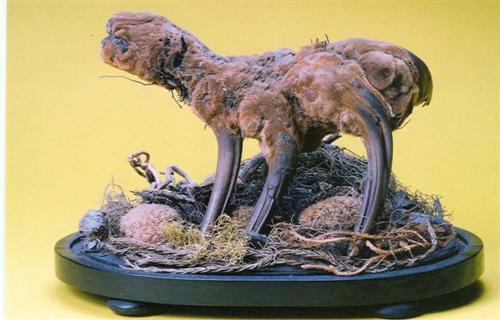
Vegetable Lamb from The Museum of Garden History, London
"Art Historian collective Porter & Jenkinson aim to showcase the best contemporary art of a curious and unusual nature. Through exploring the dark, strange and depraved themes of the Victorian era they curate exhibitions of works that respond directly to these ideas. They intend to bring to the foreground these forgotten aesthetics and to explore the responses and reactions in contemporary society."
Porter & Jenkinson's first exhibition, Curious Pursuits, will be taking place from the 2-29th February 2012 at the Portico Library in Manchester, and they are still accepting submissions until 31 December if you happen to be of artistic skill. If you are not so lucky, it should still prove a fascinating exhibition, well worth a trip to Manchester if you're not based in the area.

If Manchester seems a bit far to go, then their website - while still relatively new - is already exhibiting some interesting content, and we look forward to seeing what other finds they will post next.

Wednesday, 26 October 2011

A Grotesque Aesthetic? The Anatomia Collection

Joseph Maclise, Pl.III "Dissection of the
Neck and Thorax, Heart and Blood Vessels"
Surgical Anatomy (1856).
We would like to draw your attention to an absolutely fabulous resource provided absolutely free by the University of Toronto - perfect for researchers in the medical humanities, or anyone with an admiration for exquisite anatomical art. Please indulge yourself and explore The Anatomia Collection: 4500 anatomical plates from the Thomas Fisher Rare Book Library, digitised and free to the public. The plates range in date from 1522-1867, and are fully indexed using medical subject headings (MeSH).

If you have perused our blog thoroughly, you might already have noticed that the gorgeous sketch depicting the face and skull of conjoined twins which we have selected as our header image is a section of a plate from Joseph Maclise's Surgical Anatomy (1856), all of the plates from which are available through the Anatomia Collection. This particular image was chosen not simply because of what it represented, but because Maclise's style itself, in this plate as throughout his body of work (pun fully intended), seems designed to elicit a highly sensual reaction.

His sketches often depict the hooks, strings, and instruments used to expose successive layers of flesh, vessels, and organs, remnants of the intrusion of medical probing which are typically erased from anatomical sketches. And also unlike many medical sketches, which hide the faces of their subjects, or else strip them of their identity, Maclise's "dissected figures", to quote the collection's description of the text, "seem almost life-like, with real faces, usually of young men with fair hair."

Joseph Maclise, Pl. 2 "Arteries, Veins, and
Nerves of the Thorax and Neck" in Richard Quain's
Anatomy of the Arteries of the Human Body (1844)
The description goes on to suggest that, "endowed with great dignity, the figures resemble the romantically noble heroic figures in his brother's paintings" (his brother being the artist Daniel Maclise). The assertion that Maclise endows his figures with dignity and romantic nobility is not necessarily untrue, but a scan through his work will reveal bodily contortions that seem more indicative of violent ecstasy, even torture, scattered throughout the romantic heroes. Amongst these evidently "life-like" figures also rises the gaunt, unavoidably lifeless face of one man, who simultaneously evokes images of decay, even of intense starvation.

Maclise's detailing of the feathered hair clinging to skin even as it is pulled apart to reveal each layer beneath, of the instruments that rip and tear as much as they slice, leaving ragged flaps as a grotesque frame, all of this casts a reflection of the dissected corpse on the page (or screen) onto the body of those observing it. As much as some images may evoke dignity and heroics, Maclise's overall style draws attention to a grim sensuality of dissection that is absent from many medical sketch. As he exposes the mystery of muscles and bones and blood vessels, his drawings render the subject/body monstrous; twisted, tortured, ecstatic, open bodies intimately tied to the living observer through an evocation of shared sensuality.

Tuesday, 13 September 2011

Grotesque Bodies

If you are passionate about film and television monsters, featuring explicit gore, graphic violence and depictions of various taboos, Intensities: The Journal of Cult Media might have the right ingredients to satisfy your particular appetites. To be more specific, Intensities No. 4, December 2007, offers a special edition entitled Mysterious Bodies, containing a range of brilliant essays on alien bodies, vampires, ‘Gothic’ body parts, sex and violence in the Muppet Show, the dead bodies of CSI: Crime Scene Investigation and many others.

Gerard de Lairess, Plate T.55, "Abdominal Organs, Uterus
and Placenta of  a Pregnant Woman" from Govard
Bidloo's Anatomia Humani Corporis (1685)
Images are copyright the University of Toronto Library
The edition includes an article by Peter Hutchings entitled ‘Grotesque Bodies and the Horror of Comedy in League of Gentlemen’ which deserves special mention, especially for its illuminating comments regarding the show’s dark humor, acceptability, graphic depictions of decomposing, dissected grotesque bodies and its distinctiveness resisting simplistic explanations and contextualization.

Opening the article, Hutchings writes:
The comedy show 'The League of Gentlemen', which first appeared on British television in 1999 and ran until 2002, was probably not to everyone’s taste. Themes explored through three series and a Christmas special included murder, kidnapping and imprisonment, incest , monstrosity and deformity, masturbation, transvestism and transexuality, dead children, cruelty to animals, the imbibing of urine, erotic asphyxiation, vampirism, voodoo, implicit cannibalism (a rare moment of restraint), limb grafting and a plague of nosebleeds. Add nudity, some violence and gore, the occasional use of the word 'fuck', and an obsessive fixation on bodies marked in various ways as grotesque, and you end up with a most unusual recipe for TV comedy.
This ‘unusual recipe’ produced a clever work whose very cleverness, in Hutchings' view, shielded it from ‘accusations of vulgarity and coarseness and made it a suitable object for critical praise.’ The show, comparable to Monty Python, intelligently invokes comic and horror traditions creating a rich fabric of cultural references. Hutchings also reflects on the characters’ physical grotesquerie, which served as a starting point for the show’s characterizations, driven by obsessive desires and impulses and the role of transvestism where the male performers frequently play the roles of both male and female. The article concludes with an illuminating examination of the grotesque bodies in terms of horror, parts of which deserve to be quoted in full:
Cornelis Huyberts, Thes: 7, tab. 2 (Brain with pia mater,
arm of a child, hydatiform mole, fetal membranes,
lips), from Frederic Ruysch,
Opera omnia anatomico-medico-chirurgica 
(1737) 
In this veritable parade of attractions, grotesque bodies provide some continuity, with body-anxiety a major theme, albeit one that is modulated in different, generically specific ways as the show progresses. The deployment of grotesque bodies, defined in relation to both comedy and horror traditions, also helps to articulate the peculiar televisual character of a show that seems very much to be defining itself in terms of the limits of what can actually be shown on television. (…) Repeatedly, the emphasis is on what we cannot see, with the limits of our vision of ten associated with partially glimpsed bodies. We cannot see the source of the infected meat (although we might presume that it is human flesh), we cannot see the monster above the shop, we cannot see Barbara in all her transsexual glory. Instead the show alludes to extra - televisual generic worlds that are not fully representable within television itself, with those allusions drawing the attention of an audience – or at least a generically knowledgeable audience – precisely to what they are missing. 
Finally, the monstrous, dissected, infected, distended, distorted and transgressive bodies featured in this article remain rich in allusions and contradictions, leaving us wondering, intrigued by their distinctiveness as we fill the gaps with our own imagination. Whether your exploration of monstrous bodies as depicted in both film and in television concerns gender politics, sexuality, horror, humor, the grotesque, gore, explicit violence, fetishism, breaking taboos and numerous others, the articles featured in this edition might inspire criticisms or simply - spark your research interests and encourage your imagination.