Communication and Construction of Monstrous Embodiment
June 15-16, 2012

Showing posts with label freak shows. Show all posts

Monday, 13 February 2012

Fantastic Films, Fantastic Bodies

Our deepest apologies for the delay in posts; naturally we have been stunned into silence by the quality and volume of the proposals we have received in the last few weeks (and months). There's still a few days left to submit your abstracts - see the call for papers for details - so we hope to see a few more yet.

We'd also like to hopefully make up for our blog silence by bringing your attention to a very interesting article published in 2006 in Offscreen - David Church's "Fantastic Films, Fantastic Bodies: Speculations on the Fantastic and Disability Representation". The article offers an exploration of representations of disability in films whose potential to render "positive critical readings and powerful depictions of disability" has often been neglected. In fact, the "fantastic" films that form the basis for Church's discussion - namely Freaks (1932), Edward Scissorhands (1990), and Videodrome (1982) - are more likely to be the focal point for negative criticism regarding their depictions of exceptional bodies than anything else, and in the case if Freaks this has typically been the case.

Church opens by addressing such criticism, emphasising the importance of genre in influencing the way that such representations are read. He notes that
'Although fantastic films stimulate the imagination, many of them also stimulate the body itself through the devices common to “body genres” (i.e., horror, porn, and melodrama); Hawkins, for example, notes the predominance of body genre affect in art-horror, avant-garde films, and various “paracinematic” films that easily classify as fantastic. With the direct appeals to the viewer’s body made by these “low” fantastic texts (not unlike the fearful and tearful affect sought by freak show practitioners showcasing “monstrous,” exotic, sexually ambiguous, and pitiable human specimens), perhaps it is not surprising that they have been ignored by disability studies scholars seeking to displace the site of disability away from the material bounds of the corporeal body... [however,] disability studies focuses its probing and analytical gaze upon the “proper” (or “normal”) body of social realist films, largely ignoring the “grotesque” and “improper” (or “abnormal”) body of fantastic films, leaving a conspicuous gap in the discipline’s critical discourses'
Offering a lengthy dissection of three "fantastic" cinematic representations of extraordinary bodies, Church raises some intriguing questions regarding the legitimacy accorded or denied portrayals of disability based often primarily on the basis or exclusion of the context within which the portrayal is presented. He concludes by considering that 'the imaginative framework of the fantastic film moves the grotesque disabled body from the margins of representation and into the spotlight, much like the freak show performer on stage: an exploitative spectacle for sure, but one which might inadvertently point back toward our own cyborgian mode of spectatorship.'

Wednesday, 18 January 2012

Freakery and "Aesthetic Traces"

If you happen to be interested in "freaks," freakery, and its relationship to nineteenth-century medical "monsters", we'd like to draw your attention to a fascinating article published in 2005 in the Disability Studies Quarterly, Sheila Moeschen's "Aesthetic Traces in Unlikely Places: Re-visioning the Freak in 19th-Century American Photography". The article, which is open access, offers an intriguing reading of the role that photography played in the creation and presentation of extraordinary bodies in the nineteenth century; Moeschen denies that fictive division which might separate the objective medical photograph from its public side-show counterpart, typically deemed to be more deliberately titillating. Instead, she suggests,
"The two traditions form a reciprocal relationship that illuminates their representational and political imbrications. The historical persistence to delineate between a medical and artistic "aesthetic" reveals a disconcerting bias towards privileging the power and credibility of the empirical realm over the artistic."
Moeschen points to the role that "sensation" played in separating the clinical photograph of medical monstrosity from the "freak portrait", evoking perhaps a distinction between the sensational props and posing of the visual construction of freakery with the potentially sensualised medical photographs which are marked by their nudity in order to reveal the anomalous body more fully to the viewer.

The article focuses on what Moeschen calls the "performative trace," which she sees as characterising the construction of both medical and sensational photographs of individuals with extraordinary bodies, creating "an alternate frame around these subjects that explicitly signals the perceptual and cognitive apparatuses ascribed to performance." She notes that
"The performative trace becomes another presentational "mode" employed, ironically in the case of the medical profession, to disarm these unusual bodies, endowing them with a quality of the ephemeral that ultimately promotes uncritical fascination; it promotes a kind of fetishistic voyeurism and illicit titillation."
The instability which this theatrical element introduces into these photographs is, for Moeschen, a deliberate strategy on the part of both medical and sideshow photographers to manipulate the "cultural and ideological value" of their subjects.

Saturday, 14 January 2012

Welcoming 2012 (a wee bit late)

We are back! Hello, and happy new year, and our deepest apologies for such a long silence. It had been our intention to post a little bit over the holidays, but like most holiday goals we fell short and were lost in a well-spiced mulled-wine abyss for much longer than we expected.

However, to kick off the year we'd like to draw attention to a kind of companion post which ties in surprisingly well to our last post of 2011. This article by Susan Dominus was brought to our attention recently and seemed rather appropriate given the news we brought you around Christmas time of the successful birth of conjoined twins Jesus and Emanuel in Brazil.

Dominus' article, (and warning, it is quite a long-winded one), focuses on conjoined twins Krista and Tatiana Hogan in British Columbia, Canada, who, as craniopagus conjoined twins, raise quite a different question regarding subjectivity and separation. In many ways, the interest isn't any different from the traditional obsession with conjoined twins' shared experience and exactly how far it extends - experiments exploring shared sensation never seem to change much beyond the pinching and prodding of first one twin and then the other. However the notion of a thalamic bridge does seem to offer a uniquely complex set of questions regarding Krista and Tatiana's development and the prospects for their future identity.

The article also raises and glosses over some of those aspects of life as conjoined twins which have historically always seemed to hover in the shadows. While she specifically refers to the family's refusal to subject the twins to unnecessary medical study (“If one of them needs it for their health, by all means, they can do what they need to do,” said their step-grandfather... “But I’ll be damned if you’re going to poke and prod and experiment on them”), she also makes extensive reference to the response of the medical community to the discovery of the supposed thalamic bridge.

Similarly, the article appears to emphasise the girls normality, almost going so far as to suggest an absence of any spectacular element in their public lives (“Guests might have looked for a half-second longer than they ordinarily would, but they invariably smiled at the sight of the girls’ evident glee, just as they would at any other two small children”) and yet refers not only to the fact that the girls have been the subject of a documentary (on the National Geographic channel, to be precise), but also rather glossing over the family's pursuit of a reality television show.

This endeavour seems to be inspired by talent manager Chuck Harris, who in this interview is titled a “freak wrangler, manager and talent agent ”, and who refers to himself as  “the conductor of a symphony of wackos... When you need something strange and eye-popping and nobody knows where to look, I’m the guy to find it for you.”

While the idea that the twins may share more than just physical sensation is a fascinating one, and no one seems to deny that it poses brand new implications for understanding subjectivity and a sensed embodiment, their labelling on the part of one neuroscientist as “a new life form” and their engagement with a self-identified “freak-wrangler” seem to raise some unfortunately more familiar ghosts of the past.

Tuesday, 15 November 2011

A Monster Observatory

One of our keynotes, Jeffrey Jerome Cohen, shared this fantastic link with us via his Twitter account, and we wanted to pass it along to our readers as well (share and share alike - it's a good motto).

With a name like A Monster Observatory and a tagline that runs "Cultural Teratology: Freaks, Monsters, the Grotesque", it should be pretty clear why we've taken an interest in this blog. However, if you needed convincing, we would refer you to the most recent post as of today, "Thinking About Monster Theory (Seven Theses)" - ten points if you can guess what it is about.

The site is managed by Dr Ian McCormick, and so far features a wealth of posts on mangled torsos, disability and the fourth plinth, and conjoined twins amongst other topics - in other words, every fascinating aspect of monstrosity, disability, and the grotesque body. If you're reading this blog, then A Monster Observatory probably deserves a spot on your bookmarks toolbar.

We'd also like to take this opportunity to remind everyone that we do acknowledge all inquiries and submissions, so if you have sent in a proposal or a question and haven't heard back, do get in touch. Likewise if you think there's something that our blog readers might find interesting or useful - articles, books (ideally available online), art or museum exhibitions, other blogs, even other conferences. You can send it our way via e-mail, Facebook, or Twitter (all information on the sidebar to your right). Pick your poison - we'd love to hear from you on any platform!

Friday, 4 November 2011

Curious Pursuits Exhibition, Manchester

For the Victorianists amongst you, we would like to direct attention to a new Art Historian collective based in Manchester, Porter & Jenkinson. Their mission statement should prove intriguing not just to scholars focusing on the nineteenth century, but also artists, art historians, and those interested in the medical humanities:
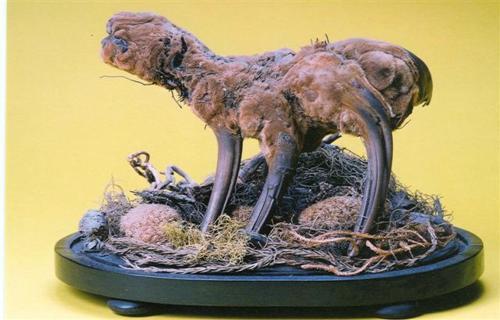
Vegetable Lamb from The Museum of Garden History, London
"Art Historian collective Porter & Jenkinson aim to showcase the best contemporary art of a curious and unusual nature. Through exploring the dark, strange and depraved themes of the Victorian era they curate exhibitions of works that respond directly to these ideas. They intend to bring to the foreground these forgotten aesthetics and to explore the responses and reactions in contemporary society."
Porter & Jenkinson's first exhibition, Curious Pursuits, will be taking place from the 2-29th February 2012 at the Portico Library in Manchester, and they are still accepting submissions until 31 December if you happen to be of artistic skill. If you are not so lucky, it should still prove a fascinating exhibition, well worth a trip to Manchester if you're not based in the area.

If Manchester seems a bit far to go, then their website - while still relatively new - is already exhibiting some interesting content, and we look forward to seeing what other finds they will post next.

Wednesday, 5 October 2011

Encountering Unexpected Bodies

For a discussion on extraordinary bodies, freak shows, monsters and staring, check out Rosemarie Garland Thomson's concise and informative article 'Staring at the Other' which traces unusual embodiments from ancient times to present day. The article highlights the shifting terminology attached to these unexpected bodies (monsters, freaks, prodigies, disabled) dependent on socio-historical context as well as the nature of people's interest in them (manifested usually in the phenomenon of 'staring'), ranging from adoration, hostility, reverence and repulsion. Reflecting on freak shows and the changing meanings surrounding the anomalous form, Thomson writes:

Freaks were spectacular public displays of novelty that entertained viewers who gladly paid to stare. Droll and fascinating freak figures were created from the unusually embodied by way of exaggeration, irony, and theatrical staging. What we now consider the medical dermatological condition of vitiligo, for example, was parlayed into the act of Spotted Boys. Giants and Midgets appeared juxtaposed together to highlight their differences. Fat Ladies titillated with cute diminutive stage names such as Dolly Dimples. The ordinary microcephalic black man became the exotic Missing Link dressed up in an ape suit. Spears and loincloths transformed albino twins into Wild Men of Borneo. Amputees became Armless Wonders by cutting out paper dolls, penning calligraphy, and drinking tea with their toes. The freak show validated curiosity and authorized public staring at bodies that departed from the ordinary by embellishing differences to make money.

The article ends with an examination of contemporary discourses surrounding monstrous embodiment, contextualized with the advent of technology, progress of medicine and the 'potent medium of television spectacle' which aimed to place these bodies back into the spotlight.
Is the wondrous freak gone altogether in our society? How can a historical approach to extraordinary embodiment inform our modern sensibilities? Thomson tellingly concludes that the unexpected bodies have been 'edited out of the human community like textual errors in the path of automatic spell checkers.'
If you are interested in this scholar and her landmark works in the field of disability studies, visit her official page featuring many helpful links and videos!

Sunday, 18 September 2011

Constructing The Hottentot Venus

Those of you interested in nineteenth century freak shows and the complexities of exhibiting 'cultural otherness', or the (de)humanization of the 'freak' and / or 'specimen', will certainly come across the diverse and often conflicting views on Saartjie (or Sarah) Baartman also known as the Hottentot Venus.

Stripped of her cultural context, Baartman was exhibited as one of the most popular 'freaks' in the nineteenth century, whose body was exposed to curious viewers as a spectacle of 'cultural otherness'. Baartman was presented to viewers in a cage, dressed in a tight fitting costume which emphasized her distinctive shape. Her breasts, buttocks and hypertrophied genitalia became the nineteenth century symbol for excessive and deviant female sexuality and inspired numerous primitivist ideologies which equated her with an animal. This voyeuristic exhibiting of her body continued long after her death, resulting in numerous discourses on gender, sexuality, race, colonialism and ethnocentrism.

In case you have access to it, you might find useful Sander L. Gilman's influential and frequently quoted article entitled 'Black Bodies, White Bodies: Toward an Iconography of Female Sexuality in Late Nineteenth-Century Art, Medicine and Literature' (Critical Inquiry 12, Autumn 1985) where he explores the representations of individuals in art which is frequently 'iconographic' in character, in which specific individuals represent particular 'classes' of people, especially when they are perceived as 'the other' and different to 'Western white male' concepts of normality. In referring to the Hottentot Venus, the article provides an exploration of racial stereotypes and their relationship to constructions of deviant sexuality. More specifically, Gilman discusses the 19th century fascination with Baartman's overtly sexualized 'anomalous' body parts, explaining it in the following terms:

Sarah Baartman's sexual parts, her genitalia and her buttocks, serve as the central image for the black female throughout the nineteenth century. And the model of de Blainville's and Cuvier's descriptions, which center on the detailed presentation of the sexual parts of the black, dominates all medical description during the nineteenth century. To an extent, this reflects the general nineteenth-century understanding of female sexuality as pathological: the female genitalia were of interest partly as examples of the various pathologies. (...) Sarah Baartman's genitalia and buttocks summarized her essence for the nineteenth century observers, or, indeed, for the twentieth century one.

This fascination with her body parts and her subsequent treatment as a preserved specimen additionally commodified her body, constructing it as simply another item to be collected and displayed. Dehumanized in medical reports, dissected and once again exposed after death, her voice remained largely obscured.
Another interesting article which highlights the importance of contextualization is Sadiah Qureshi's article 'Displaying Sara Baartman, the 'Hottentot Venus' (History of Science, Vol.42, 2004) which points to the processes involved in Baartman's objectification, politicization, exhibition and preservation. By examining these processes, it is possible to new perspectives on her story as well as 'historicize her tale'. Considering Baartman's agency, Qureshi writes:

A significant factor is the lack of agency Baartman inevitably possesses in any retelling of her story, since all the surviving records are accounts of her, rather than diaries or letters from her. Consequently, it is precisely the difficulty in recovering her agency that makes her amenable to employment as a cipher, even her minimal presence being enough; unfortunately this only constitutes further to her dispossession.

In the end, what can we know of Baartman's person? It seems to be an ever-evolving pursuit: by exploring the construction of the 'Hottentot Venus', critically reflecting on numerous existing discourses surrounding her (the sea of publications and biographies) as well as and contextualizing Baartman's story, it is possible to open new perspectives (and questions) on the life and experiences of this remarkable woman, whose real name still remains - unknown.