Communication and Construction of Monstrous Embodiment
June 15-16, 2012

Showing posts with label cabinet of curiosities. Show all posts

Thursday, 5 April 2012

Rare, Beautiful, Disturbing

First: a reminder that there are only 10 days to register for the conference at the reduced rates. Advanced booking closes on 15 April, and we urge you to take advantage of this offer before it does: see the Fees and Information tab for details and links to the booking website.

Now, we'd like to thank one of our Twitter followers for the following link to Wired Science's sneak peek at the very recently released book Hidden Treasure. The book provides a brief glimpse into the unfathomable depths of the National Library of Medicine's extensive collection as part of the NLM's 175th anniversary celebrations. The Wired Science preview is comprised of images, film rolls, or texts which are distinguished by being rare, beautiful, and disturbing.

The cross-section is an intriguing one, and perhaps indicative of the close-knit relationship between the sensational, and the beautiful/disturbing. A mummified and mutilated hand from Eugène-Louis Doyen's Atlas of Topographic Anatomy (1911), its lines pronounced and severed, seems to be the visualised anticipation of some grotesque touch; the presence of a similarly disembodied hand clutching the shoulder of a bandaged patient in Joseph Jacob-Henri's sketch from Complete Study of the Human Anatomy (1831-54) perverts the reassurance of bodily contact.

The book itself, according to the publisher's description, is an exhibition of objects that 'glow with beauty, grotesquery, wit and/or calamitous tragedy'. Edited by Michael Sappol, the collection includes 'a series never before reproduced of hauntingly delicate paintings and illustrations of “monstra” collected in the early decades of the nineteenth century “from the museum of Dr. Klinkenberg” in the Netherlands; charming hand-painted glass “magic lantern slides,” which doctors projected in slideshows to entertain and help cure inmates at St. Elizabeths Hospital for the Insane; the mimeographed report of the Japanese medical team first to enter Hiroshima after the atomic blast'.

The illustrated "monstra" are exhibited alongside disturbing images of inhumanity, and the anatomical reality of our bodies themselves. The collection also includes x-rays from Adolph Hitler's medical records, illustrations of a man so often deemed monstrous that are unnervingly devoid of the bodily monstrosity depicted elsewhere in the collection. Each treasure is accompanied by a brief essay from distinguished scholars, artists, or physicians, including Lisa O'Sullivan, Mark S. Micale, Jeffrey S. Reznick, Benjamin Reiss, Shigehisa Kuriyama, Susan E. Lederer, and Rosamond Purcell, among many others.

Tuesday, 15 November 2011

A Monster Observatory

One of our keynotes, Jeffrey Jerome Cohen, shared this fantastic link with us via his Twitter account, and we wanted to pass it along to our readers as well (share and share alike - it's a good motto).

With a name like A Monster Observatory and a tagline that runs "Cultural Teratology: Freaks, Monsters, the Grotesque", it should be pretty clear why we've taken an interest in this blog. However, if you needed convincing, we would refer you to the most recent post as of today, "Thinking About Monster Theory (Seven Theses)" - ten points if you can guess what it is about.

The site is managed by Dr Ian McCormick, and so far features a wealth of posts on mangled torsos, disability and the fourth plinth, and conjoined twins amongst other topics - in other words, every fascinating aspect of monstrosity, disability, and the grotesque body. If you're reading this blog, then A Monster Observatory probably deserves a spot on your bookmarks toolbar.

We'd also like to take this opportunity to remind everyone that we do acknowledge all inquiries and submissions, so if you have sent in a proposal or a question and haven't heard back, do get in touch. Likewise if you think there's something that our blog readers might find interesting or useful - articles, books (ideally available online), art or museum exhibitions, other blogs, even other conferences. You can send it our way via e-mail, Facebook, or Twitter (all information on the sidebar to your right). Pick your poison - we'd love to hear from you on any platform!

Friday, 4 November 2011

Curious Pursuits Exhibition, Manchester

For the Victorianists amongst you, we would like to direct attention to a new Art Historian collective based in Manchester, Porter & Jenkinson. Their mission statement should prove intriguing not just to scholars focusing on the nineteenth century, but also artists, art historians, and those interested in the medical humanities:
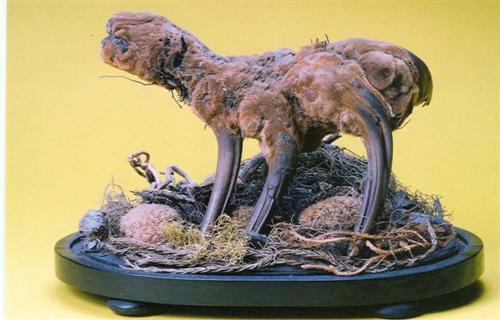
Vegetable Lamb from The Museum of Garden History, London
"Art Historian collective Porter & Jenkinson aim to showcase the best contemporary art of a curious and unusual nature. Through exploring the dark, strange and depraved themes of the Victorian era they curate exhibitions of works that respond directly to these ideas. They intend to bring to the foreground these forgotten aesthetics and to explore the responses and reactions in contemporary society."
Porter & Jenkinson's first exhibition, Curious Pursuits, will be taking place from the 2-29th February 2012 at the Portico Library in Manchester, and they are still accepting submissions until 31 December if you happen to be of artistic skill. If you are not so lucky, it should still prove a fascinating exhibition, well worth a trip to Manchester if you're not based in the area.

If Manchester seems a bit far to go, then their website - while still relatively new - is already exhibiting some interesting content, and we look forward to seeing what other finds they will post next.

Saturday, 29 October 2011

A Hallowe'en Treat: Surgeon's Hall Museum, Edinburgh

If you happen to be in the Edinburgh area this weekend, we recommend that you stop in to the Surgeon's Hall Museum to explore their fantastic collections and exhibits. It is their last open weekend this year, which is appropriate, since today and tomorrow are potentially the best possible days for exploring an exhibit about pathological anatomy, or the history of surgery, or Sherlock Holmes and his real-life counterpart, Charles Bell. They will still be open during the week, which means you are also welcome to visit on Hallowe'en itself. The museum is open from 12-4 Monday to Friday, and the weekend openings should start again in April.

The Surgeon's Hall Museum, Edinburgh
The Surgeon's Hall Museum also runs many special events and lectures in the stunning William Playfair building, so if you are local or planning a trip to the area, you might consider exploring their website to see whether they have anything exciting coming up (recent examples include the Pathology: A Day in Medical Detection event in October, while November and December feature tours on the history of medicine pre-anaesthesia and a talk on Scottish anatomists). You can also follow them on Twitter for updates and some fantastic links about the history of medicine.

If you aren't in Edinburgh, that doesn't mean you can't partake of the fun: come to the conference in June where we will be organising an opportunity to explore this amazing museum.

Have a deliciously monstrous Hallowe'en!

Sunday, 11 September 2011

Cute & Creepy Exhibition in Florida

Sadly for us, all of the organisers of the Sensualising Deformity conference are based in Edinburgh, which means we cannot attend the absolutely fantastic and grotesque Cute and Creepy exhibition at the Museum of Fine Arts at Florida State University in Tallahassee. But we can help encourage others to attend in our stead, and hope that they will bring back tales of their creepy experiences. The exhibit will be held between 14 October and 20 November of this year, so there's plenty of time yet to plan your trip; perhaps your family or friends might enjoy a trip to Disney World while you nip off for some monstrous pop surrealism?

The site's home page offers different examples of the work, or the kind of work, that will be offered at the exhibit, and based on that alone there is no question that it would be of interest to this conference and anyone reading the blog, but as if to ensure no further doubt, curator Carrie Ann Baade writes,
To see beauty in the carnivalesque or macabre, in freaks and in monsters, is a matter of aesthetics. Most of us can agree on the artistic value of a Monet or Titian but this work is for a daring audience, an audience open to exploring the strange beauty and the ecstasy inherent in our culture's aversions.
Travis Louis, The Curse of the Goat, 2006.
There is something that makes us uneasy when confronted by the weird or the unusual. Those who can appreciate both have come to anticipate and enjoy unexpected sensations. Work of this nature is not going to be an underground movement any longer: the grotesque is going mainstream.
The website also offers a tantalising excerpt of Nancy E. Hightower's essay "Revelatory Monsters: Deconstructive Hybrids, the Grotesque, and Pop Surrealism" that is included in the exhibition catalogue, which is worth quoting in full:
We need monsters in our lives.
We like to fear them, to run hiding under the covers or clenching a lover's arm until the monster is destroyed or banished to far off lands. they are wonderful like that, refusing to ever completely disappear from our lives, affording us the opportunity for self-introspection if we take a moment to recognize that monsters don’t die because they are essentially us(Cohen 5). Once they are eradicated from our cultural memory, we go, too. And that monstrous, wondrous body is at the heart of the grotesque. From the playful grotteschiunearthed in the Domus Aurea to demons of the illuminated manuscripts that overflowed from the margins onto the actual text, the monstrous body has always threatened what our culture has desired to contain (or perhaps more accurately, trapped, vetted, and fixed to incorporate whatever impossible standards it has set up to differentiate us from them). But the monstrous body is also prophetic in nature.
Jeffrey Jerome Cohen argues that as a “construct and a projection, the monster exists only to be read: the monstrum is etymologically ‘that which reveals’ that which warns…like a letter on the page, the monster signifies something other than itself”. What sets up this kind of fulcrum is society itself: “The too-precise laws of nature as set forth by science are gleefully violated in the freakish compilation of the monster's body. A mixed category, the monster resists any classification built on hierarchy or a merely binary opposition, demanding instead a ‘system’ allowing polyphony, mixed response (difference in sameness, repulsion in attraction), and resistance to integration…”. These kinds of juxtapositions are what form the definition of the grotesque.
Greg Simpkins, Knightengale, 2008.
Of course, with such passages accompanying the examples of art included on the home page of the site, monsterphiles who, like us, don't live anywhere near the exhibition will be working out calculations in the vain hope that a trip to Florida this autumn might be within their budget (we feel your pain). But if you happen to be so lucky as to be in Florida, or close enough for a visit, we highly recommend visiting the exhibition.

If not, perhaps you will have to do as we are doing and wistfully pass on the information to any fortune-favoured friends you might have who could attend! In the meantime, console yourself, perhaps, with a closer look at the artists involved, whose work is engaging with monstrosity in such sensational ways.

Wednesday, 7 September 2011

Audio Teratology

In the interest of inspiring discussion and debate, we draw your attention to some samples from The Teratologist music project, which released its third album, Cabinet of Curiosities Parts III & IV, this  June.

Descriptions of the albums include "an amalgamation of musique concrète, electroacoustic, harsh ambient and drone", "deep textures of acoustic and electronic composition", and "a[n] esoteric feeling generally stimulated by ritual music" - raising questions of how such industrial, electric, "harsh" music can be integrated with a project title that gestures towards a phenomenon that is more often soft, flesh-like, wrapped up within a body that is open or opening, moist, textured, palpable.

The samples do not pander to the senses, but deliberately offend them, evoking sensations that stand on the edge of paranoia, a rejection of sound which is an intrusion upon the flesh. The disembodied music forces a bodily response, tying the internal with the unnatural, external stimulus - eerily reminiscent of the teratologist himself, a figure of intrusion, of harsh metallic instruments who sought to inflict pain in his study of the monstrous body. In encompassing the discipline of teratology within a sensuous experience, what does such a project do to the monstrous specimen in the cabinet of curiosities itself, the figure which lies behind the music, which is denied any mention but remains an intrinsic part of it?

Questions, comments, disagreements, re-articulations - anything short of outright insults - are encouraged in the comments section.