Communication and Construction of Monstrous Embodiment
June 15-16, 2012

Showing posts with label art. Show all posts

Monday, 5 March 2012

Monstrosity of the "Flesh" - Diederik Klomberg

By way of apology for our continued silence this month, we would like to make a peace offering in the form of a stunning piece of film art by Netherlands-based Diederik Klomberg: Flesh. For more of Klomberg's work, visit his website.

This 8-min short film offers what almost feels like a complete sensual envelopment, the soundtrack alone evoking a sensation perhaps akin to being bathed in amniotic fluid. The womb-like audio experience is paired alongside a mesmerising transformation of flesh as clitoris becomes ear, becomes bellybutton, becomes nipple. The film is a seamless mutation of the body in which folds, crevices, orifices, and unbroken skin melt into one another with a recklessness abandonment of the traditions of human form.

Flesh is a cinematic creation of the monstrous body in pieces, the body that is always already in the process of becoming both itself and its fleshly other. Each dissected, high definition pound of flesh becomes as alien as the Elephant Man's tumorous excess, or one of H.G. Geiger's biomechanical creatures. Each image is carved out of the healthy body to take on a life of its own; the breathing, pulsing soundtrack is not that of the body in-toto, but of a new, foreign body that quivers and grows as sphincters expand and an expanse of smooth skin crumples into canyons.

Since we are in the process of setting up registration and putting together a preliminary conference schedule, updates may be few and far between yet (although we hope to see a change in that pattern soon). Until then, treat yourself for about 8 minutes. There's really nothing quite like getting lost in a rolling tide of flesh and finding yourself confronted with the glorious monstrosity of a perfectly normal nostril.

Friday, 4 November 2011

Curious Pursuits Exhibition, Manchester

For the Victorianists amongst you, we would like to direct attention to a new Art Historian collective based in Manchester, Porter & Jenkinson. Their mission statement should prove intriguing not just to scholars focusing on the nineteenth century, but also artists, art historians, and those interested in the medical humanities:
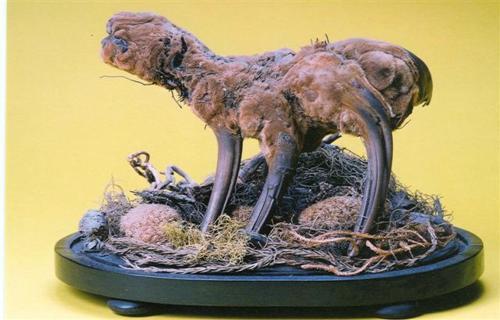
Vegetable Lamb from The Museum of Garden History, London
"Art Historian collective Porter & Jenkinson aim to showcase the best contemporary art of a curious and unusual nature. Through exploring the dark, strange and depraved themes of the Victorian era they curate exhibitions of works that respond directly to these ideas. They intend to bring to the foreground these forgotten aesthetics and to explore the responses and reactions in contemporary society."
Porter & Jenkinson's first exhibition, Curious Pursuits, will be taking place from the 2-29th February 2012 at the Portico Library in Manchester, and they are still accepting submissions until 31 December if you happen to be of artistic skill. If you are not so lucky, it should still prove a fascinating exhibition, well worth a trip to Manchester if you're not based in the area.

If Manchester seems a bit far to go, then their website - while still relatively new - is already exhibiting some interesting content, and we look forward to seeing what other finds they will post next.

Wednesday, 26 October 2011

A Grotesque Aesthetic? The Anatomia Collection

Joseph Maclise, Pl.III "Dissection of the
Neck and Thorax, Heart and Blood Vessels"
Surgical Anatomy (1856).
We would like to draw your attention to an absolutely fabulous resource provided absolutely free by the University of Toronto - perfect for researchers in the medical humanities, or anyone with an admiration for exquisite anatomical art. Please indulge yourself and explore The Anatomia Collection: 4500 anatomical plates from the Thomas Fisher Rare Book Library, digitised and free to the public. The plates range in date from 1522-1867, and are fully indexed using medical subject headings (MeSH).

If you have perused our blog thoroughly, you might already have noticed that the gorgeous sketch depicting the face and skull of conjoined twins which we have selected as our header image is a section of a plate from Joseph Maclise's Surgical Anatomy (1856), all of the plates from which are available through the Anatomia Collection. This particular image was chosen not simply because of what it represented, but because Maclise's style itself, in this plate as throughout his body of work (pun fully intended), seems designed to elicit a highly sensual reaction.

His sketches often depict the hooks, strings, and instruments used to expose successive layers of flesh, vessels, and organs, remnants of the intrusion of medical probing which are typically erased from anatomical sketches. And also unlike many medical sketches, which hide the faces of their subjects, or else strip them of their identity, Maclise's "dissected figures", to quote the collection's description of the text, "seem almost life-like, with real faces, usually of young men with fair hair."

Joseph Maclise, Pl. 2 "Arteries, Veins, and
Nerves of the Thorax and Neck" in Richard Quain's
Anatomy of the Arteries of the Human Body (1844)
The description goes on to suggest that, "endowed with great dignity, the figures resemble the romantically noble heroic figures in his brother's paintings" (his brother being the artist Daniel Maclise). The assertion that Maclise endows his figures with dignity and romantic nobility is not necessarily untrue, but a scan through his work will reveal bodily contortions that seem more indicative of violent ecstasy, even torture, scattered throughout the romantic heroes. Amongst these evidently "life-like" figures also rises the gaunt, unavoidably lifeless face of one man, who simultaneously evokes images of decay, even of intense starvation.

Maclise's detailing of the feathered hair clinging to skin even as it is pulled apart to reveal each layer beneath, of the instruments that rip and tear as much as they slice, leaving ragged flaps as a grotesque frame, all of this casts a reflection of the dissected corpse on the page (or screen) onto the body of those observing it. As much as some images may evoke dignity and heroics, Maclise's overall style draws attention to a grim sensuality of dissection that is absent from many medical sketch. As he exposes the mystery of muscles and bones and blood vessels, his drawings render the subject/body monstrous; twisted, tortured, ecstatic, open bodies intimately tied to the living observer through an evocation of shared sensuality.

Thursday, 29 September 2011

H.R. Giger's Biomechanical Aesthetic

Passionate about Alien films? Fascinated by the sublime beauty of the Alien creatures? Interested in the complex interplay of the senses, transgressions and fetishist imagery present in this type of artwork? Then take a closer look at H.R. Giger, the fascinating artist whose works inspired the Alien films and explore his surreal world of shifting shapes, mechanics, fetishes and sensualised body parts.

H.R. Giger is an acclaimed Swiss surrealist artist, painter, sculptor, designer and interior architect whose art is usually described as 'Biomechanical aesthetic' defined as 'a dialectic between man and machine, representing a universe at once disturbing and sublime'. This universe represents a unique exploration into the human body, sexuality, (de)form(ation), polymorphous creatures and their ecstatic and sensual merging with technology. Fetishist tentacles, fetuses, orifices, ruptures, skeletal structures and various fluids constitute a part of this rich space of alterity and possibility.

The best resource for Giger's works is his official website, which offers a glimpe into his immense creativity, from articles and discussions on Alien films, images of Giger bars, sculptures, furniture, books, music and theatre. It also includes an informative biography revealing more about his life and art.

The website also offers a link to the Giger Museum, which aims to engage (or challenge) our senses more directly. Situated in the medieval Château St. Germain in Gruyères, Switzerland, it houses the greatest collection of his works from 1960s to today. If you are unable to visit this magical place, the elaborately and engagingly designed websites might serve as a compensation.
Finally, I warmly recommend the 'Short films' section of the Museum website, containing numerous tributes to Giger and featuring some of his brilliant works.

Feel free to share your impressions on this fascinating artist and his creations and how this may relate to your interests / conference ideas on any of our pages!

Sunday, 11 September 2011

Cute & Creepy Exhibition in Florida

Sadly for us, all of the organisers of the Sensualising Deformity conference are based in Edinburgh, which means we cannot attend the absolutely fantastic and grotesque Cute and Creepy exhibition at the Museum of Fine Arts at Florida State University in Tallahassee. But we can help encourage others to attend in our stead, and hope that they will bring back tales of their creepy experiences. The exhibit will be held between 14 October and 20 November of this year, so there's plenty of time yet to plan your trip; perhaps your family or friends might enjoy a trip to Disney World while you nip off for some monstrous pop surrealism?

The site's home page offers different examples of the work, or the kind of work, that will be offered at the exhibit, and based on that alone there is no question that it would be of interest to this conference and anyone reading the blog, but as if to ensure no further doubt, curator Carrie Ann Baade writes,
To see beauty in the carnivalesque or macabre, in freaks and in monsters, is a matter of aesthetics. Most of us can agree on the artistic value of a Monet or Titian but this work is for a daring audience, an audience open to exploring the strange beauty and the ecstasy inherent in our culture's aversions.
Travis Louis, The Curse of the Goat, 2006.
There is something that makes us uneasy when confronted by the weird or the unusual. Those who can appreciate both have come to anticipate and enjoy unexpected sensations. Work of this nature is not going to be an underground movement any longer: the grotesque is going mainstream.
The website also offers a tantalising excerpt of Nancy E. Hightower's essay "Revelatory Monsters: Deconstructive Hybrids, the Grotesque, and Pop Surrealism" that is included in the exhibition catalogue, which is worth quoting in full:
We need monsters in our lives.
We like to fear them, to run hiding under the covers or clenching a lover's arm until the monster is destroyed or banished to far off lands. they are wonderful like that, refusing to ever completely disappear from our lives, affording us the opportunity for self-introspection if we take a moment to recognize that monsters don’t die because they are essentially us(Cohen 5). Once they are eradicated from our cultural memory, we go, too. And that monstrous, wondrous body is at the heart of the grotesque. From the playful grotteschiunearthed in the Domus Aurea to demons of the illuminated manuscripts that overflowed from the margins onto the actual text, the monstrous body has always threatened what our culture has desired to contain (or perhaps more accurately, trapped, vetted, and fixed to incorporate whatever impossible standards it has set up to differentiate us from them). But the monstrous body is also prophetic in nature.
Jeffrey Jerome Cohen argues that as a “construct and a projection, the monster exists only to be read: the monstrum is etymologically ‘that which reveals’ that which warns…like a letter on the page, the monster signifies something other than itself”. What sets up this kind of fulcrum is society itself: “The too-precise laws of nature as set forth by science are gleefully violated in the freakish compilation of the monster's body. A mixed category, the monster resists any classification built on hierarchy or a merely binary opposition, demanding instead a ‘system’ allowing polyphony, mixed response (difference in sameness, repulsion in attraction), and resistance to integration…”. These kinds of juxtapositions are what form the definition of the grotesque.
Greg Simpkins, Knightengale, 2008.
Of course, with such passages accompanying the examples of art included on the home page of the site, monsterphiles who, like us, don't live anywhere near the exhibition will be working out calculations in the vain hope that a trip to Florida this autumn might be within their budget (we feel your pain). But if you happen to be so lucky as to be in Florida, or close enough for a visit, we highly recommend visiting the exhibition.

If not, perhaps you will have to do as we are doing and wistfully pass on the information to any fortune-favoured friends you might have who could attend! In the meantime, console yourself, perhaps, with a closer look at the artists involved, whose work is engaging with monstrosity in such sensational ways.