Communication and Construction of Monstrous Embodiment
June 15-16, 2012

Showing posts with label sensualize. Show all posts

Thursday, 24 November 2011

Sensuality as Disability - Victorians and Precocious Puberty

Since this week (22 November to be precise) marked the start of Disability History Month here in the UK, we thought that it was a  good time to draw your attention to a special issue of Nineteenth-Century Gender Studies from 2008, which explores the subject of "Critical Transformations: Disability and the Body in Nineteenth-Century Britain". Best of all, the issue, guest edited by Mark Mossman and Martha Stoddard-Holmes, is available free online in full.

Pieter Paaw, "Skeleton and Skull of a
Child." (1633), © University of Toronto
Library, 2003 
The journal offers a number of interesting articles exploring the intersection of gender and disability, such as Joyce L. Huff's "The Domesticated Monster: Freakishness and Disability in Fitz-James O'Brien's 'What Was It?'". Yet what is perhaps most interesting within the context of this conference (and this blog) is the inclusion of M. Jeanne Peterson's "Precocious Puberty and the Victorian Medical Gaze".

Peterson's article considers the responses on the part of Victorian medical reports to cases of precocious puberty and the way that they were tied to anxieties surrounding conceptions of gender, bodily normalcy, even the state of childhood itself. In so doing, she demonstrates, to quote Mossman and Stoddard-Holmes's introduction to the issue, "the fecundity of visual and structural disruptions of “normal” masculinity and femininity for narratives of pathology and normalcy." The introduction goes on to note that the article
"work[s] on the continuum on which the normal and the extraordinary both reside, noting the various points (and convergences) of discomfort, apprehension, attraction, and wonder these “extraordinary cases” produce"
In consciously choosing to place early-onset puberty within the discourse of disability, Peterson acknowledges that her decision may raise some questions, given that,
"precocious puberty would seem more a case of early ability rather than disability. But early puberty can also be understood as deviance, as straying from norms of bodily development. In the phenomena of early puberty doctors found amazement, desire, and dread."
In Peterson's study, then, the precocious development of physical markers of puberty, those undeniable indicators of the body's eroticism, its sensuality, become in and of themselves an illustration of disability. This definition of the preciously pubescent body would seem to bind Victorian constructions of disability, of exceptional bodies, to the sensual body in a way which is often overlooked. Sensuality here stands at the very core of disability, in stark contrast to a traditional conception in which the senses,  if not deliberately removed, are at the very least forgotten.

Friday, 4 November 2011

Curious Pursuits Exhibition, Manchester

For the Victorianists amongst you, we would like to direct attention to a new Art Historian collective based in Manchester, Porter & Jenkinson. Their mission statement should prove intriguing not just to scholars focusing on the nineteenth century, but also artists, art historians, and those interested in the medical humanities:
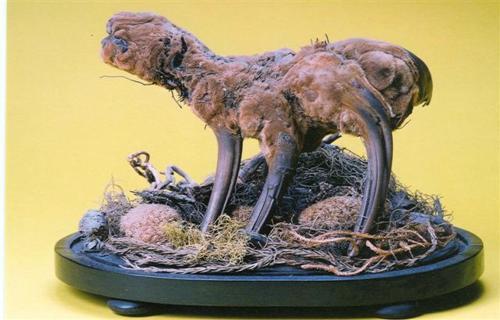
Vegetable Lamb from The Museum of Garden History, London
"Art Historian collective Porter & Jenkinson aim to showcase the best contemporary art of a curious and unusual nature. Through exploring the dark, strange and depraved themes of the Victorian era they curate exhibitions of works that respond directly to these ideas. They intend to bring to the foreground these forgotten aesthetics and to explore the responses and reactions in contemporary society."
Porter & Jenkinson's first exhibition, Curious Pursuits, will be taking place from the 2-29th February 2012 at the Portico Library in Manchester, and they are still accepting submissions until 31 December if you happen to be of artistic skill. If you are not so lucky, it should still prove a fascinating exhibition, well worth a trip to Manchester if you're not based in the area.

If Manchester seems a bit far to go, then their website - while still relatively new - is already exhibiting some interesting content, and we look forward to seeing what other finds they will post next.

Wednesday, 21 September 2011

Jeffrey Jerome Cohen, "Giants"

Julius Koch, Le Geant Constantin
Image courtesy of TheTallestMan.com
As you can probably imagine, we are looking forward to the forthcoming Ashgate Encyclopedia of Literary and Cinematic Monsters, ed. Jeffrey Weinstock, with great anticipation (it's hardly a stretch of the imagination to say that if you're reading this blog, you are too, and if you weren't before, you most definitely are now. Or at least you should be). To be totally honest, we simply cannot wait for it to be published.

Time travel was attempted (and subsequently abandoned), things were learned that cannot be unlearned, and our respective psyches were threatened with total destruction. As a result, we had no choice but to resign ourselves to the doleful realisation that, like mere mortals, we would have to wait.

But that wait has been made less torturous by Jeffrey Jerome Cohen (who, just a small reminder, will be flying all the way from Washington D.C. to Edinburgh, Scotland to be a keynote at our conference along with Peter Hutchings and Margrit Shildrick). On the In the Middle blog, he was ever so kind last month to post a draft of his entry on giants, to which we now direct your attention:
The giant pervades every level of society, from popular culture and folklore to self-consciously artistic literature and scholarly discourse. With some notable exceptions, the giant is strongly gendered male. He often figures the masculine body out of control, demarcating a cultural boundary not to be traversed. The giant is foundational. The world may have been created from the body of a giant, as in Norse fable; or the body of the earth may spawn giants, as in classical tradition. He is so elemental that humanity cannot escape his abiding presence.
Keep an eye out for the encyclopaedia itself - definitely going to be a good book to have on the shelf. 

Saturday, 17 September 2011

Plenary Speaker: Prof. Margrit Shildrick

"Lunatica", Fernando Vicente. From the series Vanitas
Copyright Fernando Vicente, 2008.
The Sensualising Deformity conference organisers are delighted to announce that Margrit Shildrick, Professor of Gender and Knowledge Production with Tema Genus at Linköping University in Sweden, will be joining Jeffrey Jerome Cohen, from George Washington University, and Peter Hutchings, from Northumbria University, to deliver a keynote lecture at the conference this June. 

We are honoured and excited to be bringing together such truly brilliant minds, each of whom offers a distinct perspective on the topic of monsters, monstrosity, and monstrous embodiment. They also reflect the interdisciplinary nature of the conference itself; despite their different research backgrounds, each have contributed significantly to our understanding of monsters and monstrosity, and are sure to add great depth and nuance to our discussions of sensuality and the anomalous body during the conference.

We look forward to offering a forum in which our speakers can communicate and engage with what we are positive will be an equally wonderful group of participants from across departments and disciplines, and encompassing the full range of the academic career spectrum.

Sunday, 11 September 2011

Cute & Creepy Exhibition in Florida

Sadly for us, all of the organisers of the Sensualising Deformity conference are based in Edinburgh, which means we cannot attend the absolutely fantastic and grotesque Cute and Creepy exhibition at the Museum of Fine Arts at Florida State University in Tallahassee. But we can help encourage others to attend in our stead, and hope that they will bring back tales of their creepy experiences. The exhibit will be held between 14 October and 20 November of this year, so there's plenty of time yet to plan your trip; perhaps your family or friends might enjoy a trip to Disney World while you nip off for some monstrous pop surrealism?

The site's home page offers different examples of the work, or the kind of work, that will be offered at the exhibit, and based on that alone there is no question that it would be of interest to this conference and anyone reading the blog, but as if to ensure no further doubt, curator Carrie Ann Baade writes,
To see beauty in the carnivalesque or macabre, in freaks and in monsters, is a matter of aesthetics. Most of us can agree on the artistic value of a Monet or Titian but this work is for a daring audience, an audience open to exploring the strange beauty and the ecstasy inherent in our culture's aversions.
Travis Louis, The Curse of the Goat, 2006.
There is something that makes us uneasy when confronted by the weird or the unusual. Those who can appreciate both have come to anticipate and enjoy unexpected sensations. Work of this nature is not going to be an underground movement any longer: the grotesque is going mainstream.
The website also offers a tantalising excerpt of Nancy E. Hightower's essay "Revelatory Monsters: Deconstructive Hybrids, the Grotesque, and Pop Surrealism" that is included in the exhibition catalogue, which is worth quoting in full:
We need monsters in our lives.
We like to fear them, to run hiding under the covers or clenching a lover's arm until the monster is destroyed or banished to far off lands. they are wonderful like that, refusing to ever completely disappear from our lives, affording us the opportunity for self-introspection if we take a moment to recognize that monsters don’t die because they are essentially us(Cohen 5). Once they are eradicated from our cultural memory, we go, too. And that monstrous, wondrous body is at the heart of the grotesque. From the playful grotteschiunearthed in the Domus Aurea to demons of the illuminated manuscripts that overflowed from the margins onto the actual text, the monstrous body has always threatened what our culture has desired to contain (or perhaps more accurately, trapped, vetted, and fixed to incorporate whatever impossible standards it has set up to differentiate us from them). But the monstrous body is also prophetic in nature.
Jeffrey Jerome Cohen argues that as a “construct and a projection, the monster exists only to be read: the monstrum is etymologically ‘that which reveals’ that which warns…like a letter on the page, the monster signifies something other than itself”. What sets up this kind of fulcrum is society itself: “The too-precise laws of nature as set forth by science are gleefully violated in the freakish compilation of the monster's body. A mixed category, the monster resists any classification built on hierarchy or a merely binary opposition, demanding instead a ‘system’ allowing polyphony, mixed response (difference in sameness, repulsion in attraction), and resistance to integration…”. These kinds of juxtapositions are what form the definition of the grotesque.
Greg Simpkins, Knightengale, 2008.
Of course, with such passages accompanying the examples of art included on the home page of the site, monsterphiles who, like us, don't live anywhere near the exhibition will be working out calculations in the vain hope that a trip to Florida this autumn might be within their budget (we feel your pain). But if you happen to be so lucky as to be in Florida, or close enough for a visit, we highly recommend visiting the exhibition.

If not, perhaps you will have to do as we are doing and wistfully pass on the information to any fortune-favoured friends you might have who could attend! In the meantime, console yourself, perhaps, with a closer look at the artists involved, whose work is engaging with monstrosity in such sensational ways.

Wednesday, 7 September 2011

Audio Teratology

In the interest of inspiring discussion and debate, we draw your attention to some samples from The Teratologist music project, which released its third album, Cabinet of Curiosities Parts III & IV, this  June.

Descriptions of the albums include "an amalgamation of musique concrète, electroacoustic, harsh ambient and drone", "deep textures of acoustic and electronic composition", and "a[n] esoteric feeling generally stimulated by ritual music" - raising questions of how such industrial, electric, "harsh" music can be integrated with a project title that gestures towards a phenomenon that is more often soft, flesh-like, wrapped up within a body that is open or opening, moist, textured, palpable.

The samples do not pander to the senses, but deliberately offend them, evoking sensations that stand on the edge of paranoia, a rejection of sound which is an intrusion upon the flesh. The disembodied music forces a bodily response, tying the internal with the unnatural, external stimulus - eerily reminiscent of the teratologist himself, a figure of intrusion, of harsh metallic instruments who sought to inflict pain in his study of the monstrous body. In encompassing the discipline of teratology within a sensuous experience, what does such a project do to the monstrous specimen in the cabinet of curiosities itself, the figure which lies behind the music, which is denied any mention but remains an intrinsic part of it?

Questions, comments, disagreements, re-articulations - anything short of outright insults - are encouraged in the comments section.


Thursday, 18 August 2011

The Sensualising Deformity Blog

One of the long-term goals of the Sensualising Deformity conference is to bring together scholars and students around the world and across disciplines who share an interest in deformity, monstrosity, or freakery, and to develop a network that connects them together.

This blog is a central part of that aim, offering links to all things related to the conference themes, be they articles, seminars, exhibitions, websites, films, or general miscellanea. We also hope to post calls for papers and contributions for other conferences or collections that are being organised in the field.

For those who may not, for whatever reason, be able to attend the conference in June, we hope the blog will ensure that you are still welcomed as part of a network of like-minded individuals, and that you will find here a source of knowledge and ideas as fascinating as the conference itself!