Communication and Construction of Monstrous Embodiment
June 15-16, 2012

Showing posts with label freakery. Show all posts

Monday, 13 February 2012

Fantastic Films, Fantastic Bodies

Our deepest apologies for the delay in posts; naturally we have been stunned into silence by the quality and volume of the proposals we have received in the last few weeks (and months). There's still a few days left to submit your abstracts - see the call for papers for details - so we hope to see a few more yet.

We'd also like to hopefully make up for our blog silence by bringing your attention to a very interesting article published in 2006 in Offscreen - David Church's "Fantastic Films, Fantastic Bodies: Speculations on the Fantastic and Disability Representation". The article offers an exploration of representations of disability in films whose potential to render "positive critical readings and powerful depictions of disability" has often been neglected. In fact, the "fantastic" films that form the basis for Church's discussion - namely Freaks (1932), Edward Scissorhands (1990), and Videodrome (1982) - are more likely to be the focal point for negative criticism regarding their depictions of exceptional bodies than anything else, and in the case if Freaks this has typically been the case.

Church opens by addressing such criticism, emphasising the importance of genre in influencing the way that such representations are read. He notes that
'Although fantastic films stimulate the imagination, many of them also stimulate the body itself through the devices common to “body genres” (i.e., horror, porn, and melodrama); Hawkins, for example, notes the predominance of body genre affect in art-horror, avant-garde films, and various “paracinematic” films that easily classify as fantastic. With the direct appeals to the viewer’s body made by these “low” fantastic texts (not unlike the fearful and tearful affect sought by freak show practitioners showcasing “monstrous,” exotic, sexually ambiguous, and pitiable human specimens), perhaps it is not surprising that they have been ignored by disability studies scholars seeking to displace the site of disability away from the material bounds of the corporeal body... [however,] disability studies focuses its probing and analytical gaze upon the “proper” (or “normal”) body of social realist films, largely ignoring the “grotesque” and “improper” (or “abnormal”) body of fantastic films, leaving a conspicuous gap in the discipline’s critical discourses'
Offering a lengthy dissection of three "fantastic" cinematic representations of extraordinary bodies, Church raises some intriguing questions regarding the legitimacy accorded or denied portrayals of disability based often primarily on the basis or exclusion of the context within which the portrayal is presented. He concludes by considering that 'the imaginative framework of the fantastic film moves the grotesque disabled body from the margins of representation and into the spotlight, much like the freak show performer on stage: an exploitative spectacle for sure, but one which might inadvertently point back toward our own cyborgian mode of spectatorship.'

Tuesday, 31 January 2012

"Freaky" terminology in Google's Ngram Viewer

Just a short post today about something that one of the conference organisers has been playing around with in liu of facing actual work. If you've encountered Google's Ngram viewer before then perhaps you have already thought to input the various words typically associated with the extraordinary body throughout history to see what you get. If not, then we'd like to share the following:

This graph represents the use of different terminology over time (from 1700 - 2000) as found in Google Books' digitized collection (click on the image for the full size, click on the in-text link for the details of search criteria or to run your own).


Breaking that down into labels which might, historically, have been associated with, or at least which now tend to be associated with historical/cultural conceptions of, extraordinary bodies - namely "monstrous," "deformed," "disabled," and "freak" - suggests some surprising trends in usage.


Below are a series of related breakdowns.

Wednesday, 18 January 2012

Freakery and "Aesthetic Traces"

If you happen to be interested in "freaks," freakery, and its relationship to nineteenth-century medical "monsters", we'd like to draw your attention to a fascinating article published in 2005 in the Disability Studies Quarterly, Sheila Moeschen's "Aesthetic Traces in Unlikely Places: Re-visioning the Freak in 19th-Century American Photography". The article, which is open access, offers an intriguing reading of the role that photography played in the creation and presentation of extraordinary bodies in the nineteenth century; Moeschen denies that fictive division which might separate the objective medical photograph from its public side-show counterpart, typically deemed to be more deliberately titillating. Instead, she suggests,
"The two traditions form a reciprocal relationship that illuminates their representational and political imbrications. The historical persistence to delineate between a medical and artistic "aesthetic" reveals a disconcerting bias towards privileging the power and credibility of the empirical realm over the artistic."
Moeschen points to the role that "sensation" played in separating the clinical photograph of medical monstrosity from the "freak portrait", evoking perhaps a distinction between the sensational props and posing of the visual construction of freakery with the potentially sensualised medical photographs which are marked by their nudity in order to reveal the anomalous body more fully to the viewer.

The article focuses on what Moeschen calls the "performative trace," which she sees as characterising the construction of both medical and sensational photographs of individuals with extraordinary bodies, creating "an alternate frame around these subjects that explicitly signals the perceptual and cognitive apparatuses ascribed to performance." She notes that
"The performative trace becomes another presentational "mode" employed, ironically in the case of the medical profession, to disarm these unusual bodies, endowing them with a quality of the ephemeral that ultimately promotes uncritical fascination; it promotes a kind of fetishistic voyeurism and illicit titillation."
The instability which this theatrical element introduces into these photographs is, for Moeschen, a deliberate strategy on the part of both medical and sideshow photographers to manipulate the "cultural and ideological value" of their subjects.

Saturday, 14 January 2012

Welcoming 2012 (a wee bit late)

We are back! Hello, and happy new year, and our deepest apologies for such a long silence. It had been our intention to post a little bit over the holidays, but like most holiday goals we fell short and were lost in a well-spiced mulled-wine abyss for much longer than we expected.

However, to kick off the year we'd like to draw attention to a kind of companion post which ties in surprisingly well to our last post of 2011. This article by Susan Dominus was brought to our attention recently and seemed rather appropriate given the news we brought you around Christmas time of the successful birth of conjoined twins Jesus and Emanuel in Brazil.

Dominus' article, (and warning, it is quite a long-winded one), focuses on conjoined twins Krista and Tatiana Hogan in British Columbia, Canada, who, as craniopagus conjoined twins, raise quite a different question regarding subjectivity and separation. In many ways, the interest isn't any different from the traditional obsession with conjoined twins' shared experience and exactly how far it extends - experiments exploring shared sensation never seem to change much beyond the pinching and prodding of first one twin and then the other. However the notion of a thalamic bridge does seem to offer a uniquely complex set of questions regarding Krista and Tatiana's development and the prospects for their future identity.

The article also raises and glosses over some of those aspects of life as conjoined twins which have historically always seemed to hover in the shadows. While she specifically refers to the family's refusal to subject the twins to unnecessary medical study (“If one of them needs it for their health, by all means, they can do what they need to do,” said their step-grandfather... “But I’ll be damned if you’re going to poke and prod and experiment on them”), she also makes extensive reference to the response of the medical community to the discovery of the supposed thalamic bridge.

Similarly, the article appears to emphasise the girls normality, almost going so far as to suggest an absence of any spectacular element in their public lives (“Guests might have looked for a half-second longer than they ordinarily would, but they invariably smiled at the sight of the girls’ evident glee, just as they would at any other two small children”) and yet refers not only to the fact that the girls have been the subject of a documentary (on the National Geographic channel, to be precise), but also rather glossing over the family's pursuit of a reality television show.

This endeavour seems to be inspired by talent manager Chuck Harris, who in this interview is titled a “freak wrangler, manager and talent agent ”, and who refers to himself as  “the conductor of a symphony of wackos... When you need something strange and eye-popping and nobody knows where to look, I’m the guy to find it for you.”

While the idea that the twins may share more than just physical sensation is a fascinating one, and no one seems to deny that it poses brand new implications for understanding subjectivity and a sensed embodiment, their labelling on the part of one neuroscientist as “a new life form” and their engagement with a self-identified “freak-wrangler” seem to raise some unfortunately more familiar ghosts of the past.

Thursday, 24 November 2011

Sensuality as Disability - Victorians and Precocious Puberty

Since this week (22 November to be precise) marked the start of Disability History Month here in the UK, we thought that it was a  good time to draw your attention to a special issue of Nineteenth-Century Gender Studies from 2008, which explores the subject of "Critical Transformations: Disability and the Body in Nineteenth-Century Britain". Best of all, the issue, guest edited by Mark Mossman and Martha Stoddard-Holmes, is available free online in full.

Pieter Paaw, "Skeleton and Skull of a
Child." (1633), © University of Toronto
Library, 2003 
The journal offers a number of interesting articles exploring the intersection of gender and disability, such as Joyce L. Huff's "The Domesticated Monster: Freakishness and Disability in Fitz-James O'Brien's 'What Was It?'". Yet what is perhaps most interesting within the context of this conference (and this blog) is the inclusion of M. Jeanne Peterson's "Precocious Puberty and the Victorian Medical Gaze".

Peterson's article considers the responses on the part of Victorian medical reports to cases of precocious puberty and the way that they were tied to anxieties surrounding conceptions of gender, bodily normalcy, even the state of childhood itself. In so doing, she demonstrates, to quote Mossman and Stoddard-Holmes's introduction to the issue, "the fecundity of visual and structural disruptions of “normal” masculinity and femininity for narratives of pathology and normalcy." The introduction goes on to note that the article
"work[s] on the continuum on which the normal and the extraordinary both reside, noting the various points (and convergences) of discomfort, apprehension, attraction, and wonder these “extraordinary cases” produce"
In consciously choosing to place early-onset puberty within the discourse of disability, Peterson acknowledges that her decision may raise some questions, given that,
"precocious puberty would seem more a case of early ability rather than disability. But early puberty can also be understood as deviance, as straying from norms of bodily development. In the phenomena of early puberty doctors found amazement, desire, and dread."
In Peterson's study, then, the precocious development of physical markers of puberty, those undeniable indicators of the body's eroticism, its sensuality, become in and of themselves an illustration of disability. This definition of the preciously pubescent body would seem to bind Victorian constructions of disability, of exceptional bodies, to the sensual body in a way which is often overlooked. Sensuality here stands at the very core of disability, in stark contrast to a traditional conception in which the senses,  if not deliberately removed, are at the very least forgotten.

Friday, 4 November 2011

Curious Pursuits Exhibition, Manchester

For the Victorianists amongst you, we would like to direct attention to a new Art Historian collective based in Manchester, Porter & Jenkinson. Their mission statement should prove intriguing not just to scholars focusing on the nineteenth century, but also artists, art historians, and those interested in the medical humanities:
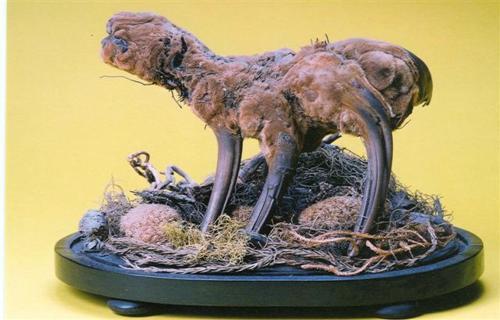
Vegetable Lamb from The Museum of Garden History, London
"Art Historian collective Porter & Jenkinson aim to showcase the best contemporary art of a curious and unusual nature. Through exploring the dark, strange and depraved themes of the Victorian era they curate exhibitions of works that respond directly to these ideas. They intend to bring to the foreground these forgotten aesthetics and to explore the responses and reactions in contemporary society."
Porter & Jenkinson's first exhibition, Curious Pursuits, will be taking place from the 2-29th February 2012 at the Portico Library in Manchester, and they are still accepting submissions until 31 December if you happen to be of artistic skill. If you are not so lucky, it should still prove a fascinating exhibition, well worth a trip to Manchester if you're not based in the area.

If Manchester seems a bit far to go, then their website - while still relatively new - is already exhibiting some interesting content, and we look forward to seeing what other finds they will post next.

Saturday, 29 October 2011

A Hallowe'en Treat: Surgeon's Hall Museum, Edinburgh

If you happen to be in the Edinburgh area this weekend, we recommend that you stop in to the Surgeon's Hall Museum to explore their fantastic collections and exhibits. It is their last open weekend this year, which is appropriate, since today and tomorrow are potentially the best possible days for exploring an exhibit about pathological anatomy, or the history of surgery, or Sherlock Holmes and his real-life counterpart, Charles Bell. They will still be open during the week, which means you are also welcome to visit on Hallowe'en itself. The museum is open from 12-4 Monday to Friday, and the weekend openings should start again in April.

The Surgeon's Hall Museum, Edinburgh
The Surgeon's Hall Museum also runs many special events and lectures in the stunning William Playfair building, so if you are local or planning a trip to the area, you might consider exploring their website to see whether they have anything exciting coming up (recent examples include the Pathology: A Day in Medical Detection event in October, while November and December feature tours on the history of medicine pre-anaesthesia and a talk on Scottish anatomists). You can also follow them on Twitter for updates and some fantastic links about the history of medicine.

If you aren't in Edinburgh, that doesn't mean you can't partake of the fun: come to the conference in June where we will be organising an opportunity to explore this amazing museum.

Have a deliciously monstrous Hallowe'en!

Friday, 21 October 2011

Fourth Plenary Speaker: Rosemarie Garland-Thomson

Earlier in the month we wrote a blog post about Rosemarie Garland-Thomson's fantastic new book, Staring: How We Look. We are therefore very honoured to be able to announce today that Prof. Garland-Thomson, Professor of Women's Studies at Emory University in Atlanta, Georgia, will be attending the conference in June as the fourth plenary speaker, joining Prof. Margrit Shildrick, Dr. Peter Hutchings, and Prof. Jeffrey Jerome Cohen. Together, these four speakers bring with them research expertise in all areas that the conference hopes to explore.

Video is copyright Emory University, 2010
Prof. Garland-Thomson's work has explored the extraordinary body in different contexts and from a variety of perspectives, from historical and cultural conceptions of freakery to contemporary reactions to and constructions of disability. Her most recent work explores our conflicted engagement with the impulse to look, and she has also put together a short video briefly discussing some of these ideas. This year (2011-2012) she also stands as a fellow at the Radcliffe Institute for Advanced Study.

Once again, we as the conference organisers would like to thank everyone who has responded so positively to the event and given their support, whether it be as keynote speakers or future delegates (we have already received some fascinating abstracts)! We are both excited and honoured to be involved in this project, and we cannot say how much look forward to working with you all.