Communication and Construction of Monstrous Embodiment
June 15-16, 2012

Showing posts with label sensualized. Show all posts

Wednesday, 18 January 2012

Freakery and "Aesthetic Traces"

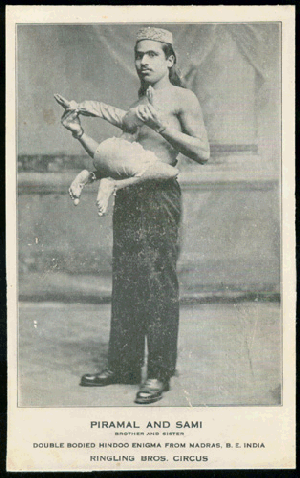
If you happen to be interested in "freaks," freakery, and its relationship to nineteenth-century medical "monsters", we'd like to draw your attention to a fascinating article published in 2005 in the Disability Studies Quarterly, Sheila Moeschen's "Aesthetic Traces in Unlikely Places: Re-visioning the Freak in 19th-Century American Photography". The article, which is open access, offers an intriguing reading of the role that photography played in the creation and presentation of extraordinary bodies in the nineteenth century; Moeschen denies that fictive division which might separate the objective medical photograph from its public side-show counterpart, typically deemed to be more deliberately titillating. Instead, she suggests,
"The two traditions form a reciprocal relationship that illuminates their representational and political imbrications. The historical persistence to delineate between a medical and artistic "aesthetic" reveals a disconcerting bias towards privileging the power and credibility of the empirical realm over the artistic."
Moeschen points to the role that "sensation" played in separating the clinical photograph of medical monstrosity from the "freak portrait", evoking perhaps a distinction between the sensational props and posing of the visual construction of freakery with the potentially sensualised medical photographs which are marked by their nudity in order to reveal the anomalous body more fully to the viewer.

The article focuses on what Moeschen calls the "performative trace," which she sees as characterising the construction of both medical and sensational photographs of individuals with extraordinary bodies, creating "an alternate frame around these subjects that explicitly signals the perceptual and cognitive apparatuses ascribed to performance." She notes that
"The performative trace becomes another presentational "mode" employed, ironically in the case of the medical profession, to disarm these unusual bodies, endowing them with a quality of the ephemeral that ultimately promotes uncritical fascination; it promotes a kind of fetishistic voyeurism and illicit titillation."
The instability which this theatrical element introduces into these photographs is, for Moeschen, a deliberate strategy on the part of both medical and sideshow photographers to manipulate the "cultural and ideological value" of their subjects.

Saturday, 14 January 2012

Welcoming 2012 (a wee bit late)

We are back! Hello, and happy new year, and our deepest apologies for such a long silence. It had been our intention to post a little bit over the holidays, but like most holiday goals we fell short and were lost in a well-spiced mulled-wine abyss for much longer than we expected.

However, to kick off the year we'd like to draw attention to a kind of companion post which ties in surprisingly well to our last post of 2011. This article by Susan Dominus was brought to our attention recently and seemed rather appropriate given the news we brought you around Christmas time of the successful birth of conjoined twins Jesus and Emanuel in Brazil.

Dominus' article, (and warning, it is quite a long-winded one), focuses on conjoined twins Krista and Tatiana Hogan in British Columbia, Canada, who, as craniopagus conjoined twins, raise quite a different question regarding subjectivity and separation. In many ways, the interest isn't any different from the traditional obsession with conjoined twins' shared experience and exactly how far it extends - experiments exploring shared sensation never seem to change much beyond the pinching and prodding of first one twin and then the other. However the notion of a thalamic bridge does seem to offer a uniquely complex set of questions regarding Krista and Tatiana's development and the prospects for their future identity.

The article also raises and glosses over some of those aspects of life as conjoined twins which have historically always seemed to hover in the shadows. While she specifically refers to the family's refusal to subject the twins to unnecessary medical study (“If one of them needs it for their health, by all means, they can do what they need to do,” said their step-grandfather... “But I’ll be damned if you’re going to poke and prod and experiment on them”), she also makes extensive reference to the response of the medical community to the discovery of the supposed thalamic bridge.

Similarly, the article appears to emphasise the girls normality, almost going so far as to suggest an absence of any spectacular element in their public lives (“Guests might have looked for a half-second longer than they ordinarily would, but they invariably smiled at the sight of the girls’ evident glee, just as they would at any other two small children”) and yet refers not only to the fact that the girls have been the subject of a documentary (on the National Geographic channel, to be precise), but also rather glossing over the family's pursuit of a reality television show.

This endeavour seems to be inspired by talent manager Chuck Harris, who in this interview is titled a “freak wrangler, manager and talent agent ”, and who refers to himself as  “the conductor of a symphony of wackos... When you need something strange and eye-popping and nobody knows where to look, I’m the guy to find it for you.”

While the idea that the twins may share more than just physical sensation is a fascinating one, and no one seems to deny that it poses brand new implications for understanding subjectivity and a sensed embodiment, their labelling on the part of one neuroscientist as “a new life form” and their engagement with a self-identified “freak-wrangler” seem to raise some unfortunately more familiar ghosts of the past.
Wednesday, 21 September 2011

Jeffrey Jerome Cohen, "Giants"

Julius Koch, Le Geant Constantin
Image courtesy of TheTallestMan.com
As you can probably imagine, we are looking forward to the forthcoming Ashgate Encyclopedia of Literary and Cinematic Monsters, ed. Jeffrey Weinstock, with great anticipation (it's hardly a stretch of the imagination to say that if you're reading this blog, you are too, and if you weren't before, you most definitely are now. Or at least you should be). To be totally honest, we simply cannot wait for it to be published.

Time travel was attempted (and subsequently abandoned), things were learned that cannot be unlearned, and our respective psyches were threatened with total destruction. As a result, we had no choice but to resign ourselves to the doleful realisation that, like mere mortals, we would have to wait.

But that wait has been made less torturous by Jeffrey Jerome Cohen (who, just a small reminder, will be flying all the way from Washington D.C. to Edinburgh, Scotland to be a keynote at our conference along with Peter Hutchings and Margrit Shildrick). On the In the Middle blog, he was ever so kind last month to post a draft of his entry on giants, to which we now direct your attention:
The giant pervades every level of society, from popular culture and folklore to self-consciously artistic literature and scholarly discourse. With some notable exceptions, the giant is strongly gendered male. He often figures the masculine body out of control, demarcating a cultural boundary not to be traversed. The giant is foundational. The world may have been created from the body of a giant, as in Norse fable; or the body of the earth may spawn giants, as in classical tradition. He is so elemental that humanity cannot escape his abiding presence.
Keep an eye out for the encyclopaedia itself - definitely going to be a good book to have on the shelf. 

Saturday, 17 September 2011

Plenary Speaker: Prof. Margrit Shildrick

"Lunatica", Fernando Vicente. From the series Vanitas. 
Copyright Fernando Vicente, 2008.
The Sensualising Deformity conference organisers are delighted to announce that Margrit Shildrick, Professor of Gender and Knowledge Production with Tema Genus at Linköping University in Sweden, will be joining Jeffrey Jerome Cohen, from George Washington University, and Peter Hutchings, from Northumbria University, to deliver a keynote lecture at the conference this June. 

We are honoured and excited to be bringing together such truly brilliant minds, each of whom offers a distinct perspective on the topic of monsters, monstrosity, and monstrous embodiment. They also reflect the interdisciplinary nature of the conference itself; despite their different research backgrounds, each have contributed significantly to our understanding of monsters and monstrosity, and are sure to add great depth and nuance to our discussions of sensuality and the anomalous body during the conference.

We look forward to offering a forum in which our speakers can communicate and engage with what we are positive will be an equally wonderful group of participants from across departments and disciplines, and encompassing the full range of the academic career spectrum.

Sunday, 11 September 2011

Cute & Creepy Exhibition in Florida

Sadly for us, all of the organisers of the Sensualising Deformity conference are based in Edinburgh, which means we cannot attend the absolutely fantastic and grotesque Cute and Creepy exhibition at the Museum of Fine Arts at Florida State University in Tallahassee. But we can help encourage others to attend in our stead, and hope that they will bring back tales of their creepy experiences. The exhibit will be held between 14 October and 20 November of this year, so there's plenty of time yet to plan your trip; perhaps your family or friends might enjoy a trip to Disney World while you nip off for some monstrous pop surrealism?

The site's home page offers different examples of the work, or the kind of work, that will be offered at the exhibit, and based on that alone there is no question that it would be of interest to this conference and anyone reading the blog, but as if to ensure no further doubt, curator Carrie Ann Baade writes,
To see beauty in the carnivalesque or macabre, in freaks and in monsters, is a matter of aesthetics. Most of us can agree on the artistic value of a Monet or Titian but this work is for a daring audience, an audience open to exploring the strange beauty and the ecstasy inherent in our culture's aversions.
Travis Louis, The Curse of the Goat, 2006.
There is something that makes us uneasy when confronted by the weird or the unusual. Those who can appreciate both have come to anticipate and enjoy unexpected sensations. Work of this nature is not going to be an underground movement any longer: the grotesque is going mainstream.
The website also offers a tantalising excerpt of Nancy E. Hightower's essay "Revelatory Monsters: Deconstructive Hybrids, the Grotesque, and Pop Surrealism" that is included in the exhibition catalogue, which is worth quoting in full:
We need monsters in our lives.
We like to fear them, to run hiding under the covers or clenching a lover's arm until the monster is destroyed or banished to far off lands. they are wonderful like that, refusing to ever completely disappear from our lives, affording us the opportunity for self-introspection if we take a moment to recognize that monsters don’t die because they are essentially us(Cohen 5). Once they are eradicated from our cultural memory, we go, too. And that monstrous, wondrous body is at the heart of the grotesque. From the playful grotteschiunearthed in the Domus Aurea to demons of the illuminated manuscripts that overflowed from the margins onto the actual text, the monstrous body has always threatened what our culture has desired to contain (or perhaps more accurately, trapped, vetted, and fixed to incorporate whatever impossible standards it has set up to differentiate us from them). But the monstrous body is also prophetic in nature.
Jeffrey Jerome Cohen argues that as a “construct and a projection, the monster exists only to be read: the monstrum is etymologically ‘that which reveals’ that which warns…like a letter on the page, the monster signifies something other than itself”. What sets up this kind of fulcrum is society itself: “The too-precise laws of nature as set forth by science are gleefully violated in the freakish compilation of the monster's body. A mixed category, the monster resists any classification built on hierarchy or a merely binary opposition, demanding instead a ‘system’ allowing polyphony, mixed response (difference in sameness, repulsion in attraction), and resistance to integration…”. These kinds of juxtapositions are what form the definition of the grotesque.
Greg Simpkins, Knightengale, 2008.
Of course, with such passages accompanying the examples of art included on the home page of the site, monsterphiles who, like us, don't live anywhere near the exhibition will be working out calculations in the vain hope that a trip to Florida this autumn might be within their budget (we feel your pain). But if you happen to be so lucky as to be in Florida, or close enough for a visit, we highly recommend visiting the exhibition.

If not, perhaps you will have to do as we are doing and wistfully pass on the information to any fortune-favoured friends you might have who could attend! In the meantime, console yourself, perhaps, with a closer look at the artists involved, whose work is engaging with monstrosity in such sensational ways.

Friday, 9 September 2011

British Medical Journal Teratological Memoranda

Images courtesy of the BMJ Publishing Group,
BMJ 1889, June 8; 1(1484): 1288–1289.
Those of you interested in teratology - 19th century especially - will probably already be quite familiar with the British Medical Journal's Teratological Memoranda, but if you haven't had a spare hour or two to browse through their older archives looking for reports of "human monsters", we would like to direct you to articles such as this, which describes the birth of three monstrous infants, a pair of conjoined twins and a limbless child whose birth is attributed to the mother having "seen a fish she never thought existed". Perhaps the most interesting thing featured in both reports is the woodcut included with each, that of the conjoined twins especially. 

In placing the figure of the twins against a black background, the gap between them and the band of flesh which binds them together are thrown into sharp relief; their faces seem closer, within kissing distance, because of the space between them. Their position seems transformed into a sensual one by the intense nearness, which is itself born of that crucial gap. Contrasted with the harshly tactile description given by the author of his involvement in their birth, focused on his probing hands and fingers, in this image it is the lack of contact which is the more sensuous.

The image of the limbless child, on the other hand, is memorable for the almost wistful expression depicted on the baby's face, its humanity over emphasised as if to counter the anomalous form below.


Thursday, 18 August 2011

The Sensualising Deformity Blog

One of the long-term goals of the Sensualising Deformity conference is to bring together scholars and students around the world and across disciplines who share an interest in deformity, monstrosity, or freakery, and to develop a network that connects them together.

This blog is a central part of that aim, offering links to all things related to the conference themes, be they articles, seminars, exhibitions, websites, films, or general miscellanea. We also hope to post calls for papers and contributions for other conferences or collections that are being organised in the field.

For those who may not, for whatever reason, be able to attend the conference in June, we hope the blog will ensure that you are still welcomed as part of a network of like-minded individuals, and that you will find here a source of knowledge and ideas as fascinating as the conference itself!